孪 (luán) means "Twins; born together." in Chinese. It has 9 strokes with the radical 子, and is HSK Level 7.
Rated 4/5 in difficulty (challenging).
Harder than 39% of HSK Level 7 characters.
Appears in 3+ common words including 孪生 (luán shēng), 孪生子 (luán shēng zi), 孪生姐妹 (luán shēng jiě mèi).
Due to its 9 strokes, Hanzi Writer's error detection shows 孪 requires focused practice — most learners need 10+ attempts for consistent accuracy.
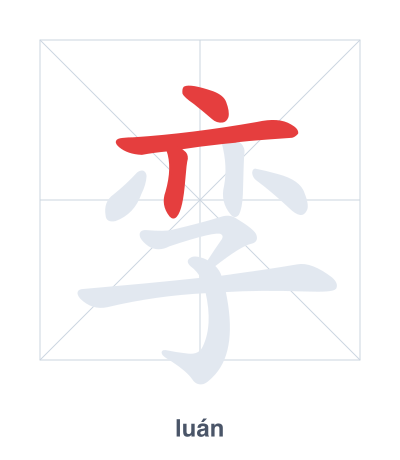
Open Hanzi Writer to see the animated stroke order and practice writing 孪 with real-time feedback.
The character 孪 (luán) is written with 9 strokes. Follow the standard Chinese stroke order: top to bottom, left to right, outside before inside. The radical 子 is one of its key components.
Practice the correct stroke order with the Hanzi Writer app to see animated stroke-by-stroke guidance with real-time feedback.
孪 means Twins; born together..
As an HSK Level 7 character, 孪 is an intermediate-level character.
孪 is a semantic-phonetic compound. The radical 子 (child) indicates the meaning relates to offspring, while the phonetic component 䜌 (luán) provides the sound and originally depicted tangled threads, suggesting the idea of two intertwined beings—hence twins born together.
💡 Memory Tip: Picture two twin babies (子) lying side by side with their tiny heads (the top portion of 孪) touching, as if curled up together at birth.
他们是孪生兄弟。
tā men shì luán shēng xiōng dì
They are twin brothers.
她生了一对孪生子。
tā shēng le yī duì luán shēng zi
She gave birth to twins.
她们是孪生姐妹。
tā men shì luán shēng jiě mèi
They are twin sisters.
Open Hanzi Writer to see the animated stroke order and practice writing 孪 with real-time feedback.
✨ Animated stroke order · Handwriting recognition · HSK-graded practice · Free to use
孪 is made of two parts: the top is 亦 (yì, meaning "also") and the bottom is 子 (zǐ, meaning "child"). Together they suggest "also a child" — that is, a second child born at the same time, which gives the meaning of twins.