辚 (lín) means "Rumbling sound of carriages." in Chinese. It has 16 strokes with the radical 车.
Rated 4.2/5 in difficulty (advanced).
Appears in 3+ common words including 辚辚 (lín lín), 辚辚声 (lín lín shēng), 辚辚而过 (lín lín ér guò).
Due to its 16 strokes, Hanzi Writer's error detection shows 辚 requires focused practice — most learners need 10+ attempts for consistent accuracy.
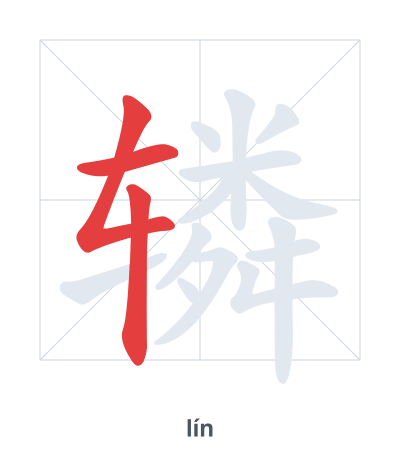
Open Hanzi Writer to see the animated stroke order and practice writing 辚 with real-time feedback.
The character 辚 (lín) is written with 16 strokes. Follow the standard Chinese stroke order: top to bottom, left to right, outside before inside. The radical 车 is one of its key components.
Practice the correct stroke order with the Hanzi Writer app to see animated stroke-by-stroke guidance with real-time feedback.
辚 means Rumbling sound of carriages..
辚 is a phono-semantic compound. The radical 车 (vehicle) ties it to carriages, while the phonetic component 粦 (lín, originally depicting fish scales or shimmering) suggests a multiplicity or continuous motion, together evoking the persistent rumbling sound of many chariots rolling by.
💡 Memory Tip: Picture a fleet of carriages (车) covered in countless shiny scales (粦) that clatter and rumble as they move—that's the sound 辚.
车声辚辚。
chē shēng lín lín
The rumbling sound of the carriage.
听到辚辚声。
tīng dào lín lín shēng
Heard the rumbling sound of carriages.
马车辚辚而过。
mǎ chē lín lín ér guò
The horse carriage rumbled past.
Open Hanzi Writer to see the animated stroke order and practice writing 辚 with real-time feedback.
✨ Animated stroke order · Handwriting recognition · HSK-graded practice · Free to use
辚 is composed of the radical 车 (vehicle) on the left and the phonetic component 粦 on the right. The radical gives the meaning of carriages or vehicles, while the right part provides the pronunciation lín and suggests the rumbling sound. Together they create the character for the rumbling noise of moving carriages.