撂 (liào) means "to put down" in Chinese. It has 14 strokes with the radical 扌.
Rated 4.2/5 in difficulty (advanced).
Appears in 3+ common words including 撂下 (liào xià), 撂挑子 (liào tiāo zi), 撂话 (liào huà).
Due to its 14 strokes, Hanzi Writer's error detection shows 撂 requires focused practice — most learners need 10+ attempts for consistent accuracy.
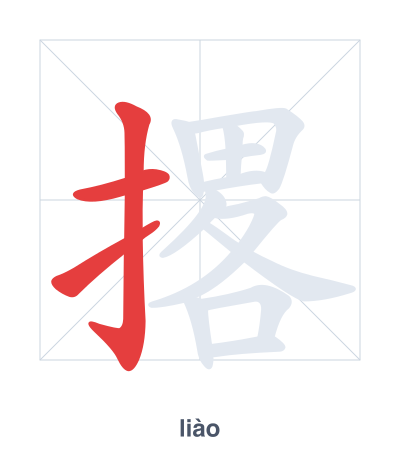
Open Hanzi Writer to see the animated stroke order and practice writing 撂 with real-time feedback.
The character 撂 (liào) is written with 14 strokes. Follow the standard Chinese stroke order: top to bottom, left to right, outside before inside. The radical 扌 is one of its key components.
Practice the correct stroke order with the Hanzi Writer app to see animated stroke-by-stroke guidance with real-time feedback.
撂 means to put down.
撂 combines the hand radical 扌 with 畧 (a variant of 略 meaning 'rough' or 'to omit'), suggesting the action of setting something down casually or carelessly.
💡 Memory Tip: Picture a hand (扌) dropping a rough sack (畧) onto the ground — that's how you 'put down' something.
他撂下了电话。
tā liào xià le diàn huà
He hung up the phone.
他突然撂挑子了。
tā tū rán liào tiāo zi le
He suddenly quit his responsibilities.
他走前撂下狠话。
tā zǒu qián liào xià hěn huà
He left some harsh words before leaving.
Open Hanzi Writer to see the animated stroke order and practice writing 撂 with real-time feedback.
✨ Animated stroke order · Handwriting recognition · HSK-graded practice · Free to use
撂 is made of the hand radical 扌 on the left, which shows an action is involved. The right side 畾 (three fields) suggests placing something flat, like laying down fields. Together they convey the idea of "putting something down" with your hand.