唎 (lì) means "A final particle used in songs or dialects." in Chinese. It has 10 strokes with the radical 口.
Rated 4.2/5 in difficulty (advanced).
Appears in 3+ common words including 哩唎 (lī lì), 唎 (lì), 哔唎哔唎 (bì lì bì lì).
Due to its 10 strokes, Hanzi Writer's error detection shows 唎 requires focused practice — most learners need 10+ attempts for consistent accuracy.
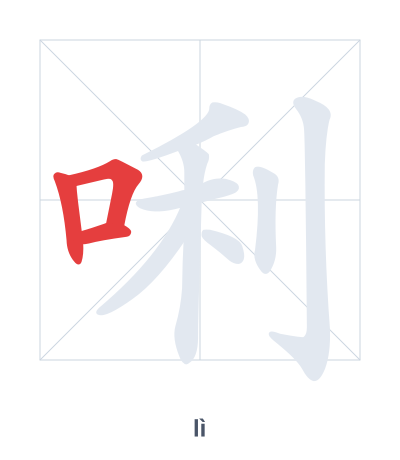
Open Hanzi Writer to see the animated stroke order and practice writing 唎 with real-time feedback.
The character 唎 (lì) is written with 10 strokes. Follow the standard Chinese stroke order: top to bottom, left to right, outside before inside. The radical 口 is one of its key components.
Practice the correct stroke order with the Hanzi Writer app to see animated stroke-by-stroke guidance with real-time feedback.
唎 means A final particle used in songs or dialects..
唎 is a compound character with the mouth radical (口) indicating speech or sound, and the phonetic component 利 (lì, meaning 'sharp' or 'benefit') providing the pronunciation. As a particle used in songs or dialects, it functions as a final exclamation or filler, similar to a musical note or vocal embellishment.
💡 Memory Tip: Imagine a singer with a sharp (利) voice opening their mouth (口) to belt out a catchy final 'lee' sound in a folk song.
哩唎的歌声很美。
lī lì de gē shēng hěn měi
The melodious singing is very beautiful.
这是一个唎音。
zhè shì yí gè lì yīn
This is a 'li' sound.
我在看哔唎哔唎。
wǒ zài kàn bì lì bì lì
I am watching Bilibili.
Open Hanzi Writer to see the animated stroke order and practice writing 唎 with real-time feedback.
✨ Animated stroke order · Handwriting recognition · HSK-graded practice · Free to use
唎 is composed of the radical 口 (mouth) on the left and the phonetic component 利 (lì, sharp) on the right. The 口 radical suggests the character is related to sounds or speech, while 利 provides the pronunciation and hints at a crisp or clear quality, matching its use as a final particle in songs.