俚 (lǐ) means "rustic; vulgar; slang" in Chinese. It has 9 strokes with the radical 亻.
Rated 3.7/5 in difficulty (challenging).
Appears in 3+ common words including 俚语 (lǐ yǔ), 俚俗 (lǐ sú), 俚曲 (lǐ qǔ).
Due to its 9 strokes, Hanzi Writer's error detection shows 俚 requires focused practice — most learners need 10+ attempts for consistent accuracy.
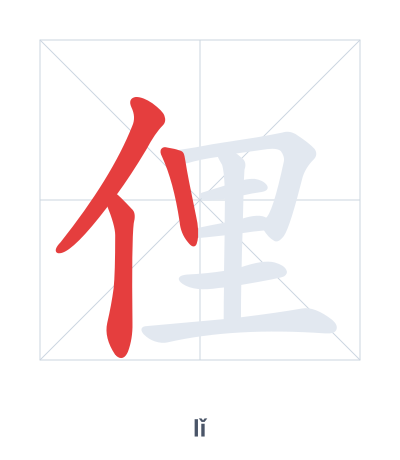
Open Hanzi Writer to see the animated stroke order and practice writing 俚 with real-time feedback.
The character 俚 (lǐ) is written with 9 strokes. Follow the standard Chinese stroke order: top to bottom, left to right, outside before inside. The radical 亻 is one of its key components.
Practice the correct stroke order with the Hanzi Writer app to see animated stroke-by-stroke guidance with real-time feedback.
俚 means rustic; vulgar; slang.
俚 combines the person radical 亻 (a person) with 里 (village or inner). In ancient China, people from remote villages were considered rustic or unrefined in speech and manners, hence the meaning 'rustic, vulgar, slang'—literally a 'village person'.
💡 Memory Tip: Picture a person (亻) from the countryside (里) spitting out vulgar slang at a fancy city party.
你知道这个俚语吗?
nǐ zhī dào zhè ge lǐ yǔ ma
Do you know this slang?
这里的俚俗很有趣。
zhè lǐ de lǐ sú hěn yǒu qù
The local customs here are very interesting.
他喜欢听家乡的俚曲。
tā xǐ huān tīng jiā xiāng de lǐ qǔ
He likes listening to local folk tunes.
Open Hanzi Writer to see the animated stroke order and practice writing 俚 with real-time feedback.
✨ Animated stroke order · Handwriting recognition · HSK-graded practice · Free to use
俚 has two parts: the radical 亻 (person) on the left, and 里 (lǐ, inside) on the right. Together, a 'person inside' suggests ordinary or local people, which connects to the meanings of rustic, vulgar, or slang used by common folk.