褵 (lí) means "a bride's sash" in Chinese. It has 15 strokes with the radical 衤.
Rated 4.2/5 in difficulty (advanced).
Appears in 3+ common words including 结褵 (jié lí), 佩褵 (pèi lí), 褵褷 (lí shī).
Due to its 15 strokes, Hanzi Writer's error detection shows 褵 requires focused practice — most learners need 10+ attempts for consistent accuracy.
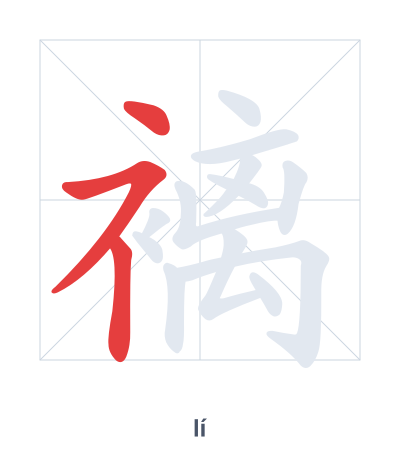
Open Hanzi Writer to see the animated stroke order and practice writing 褵 with real-time feedback.
The character 褵 (lí) is written with 15 strokes. Follow the standard Chinese stroke order: top to bottom, left to right, outside before inside. The radical 衤 is one of its key components.
Practice the correct stroke order with the Hanzi Writer app to see animated stroke-by-stroke guidance with real-time feedback.
褵 means a bride's sash.
The character 褵 is a compound of the clothing radical 衤 (yī, meaning 'garment') and the phonetic component 离 (lí). It refers to a ceremonial sash worn by a bride, with the radical indicating cloth and the phonetic hinting at the pronunciation.
💡 Memory Tip: Picture a bride's sash (衤) decorated with a pattern of tiny birds (离) flying away as she leaves her childhood home.
他们今天结褵了。
tā men jīn tiān jié lí le
They got married today.
古代女子常佩褵。
gǔ dài nǚ zǐ cháng pèi lí
Ancient women often wore bridal sashes.
羽毛看起来褵褷的。
yǔ máo kàn qǐ lái lí shī de
The feathers look disheveled and ragged.
Open Hanzi Writer to see the animated stroke order and practice writing 褵 with real-time feedback.
✨ Animated stroke order · Handwriting recognition · HSK-graded practice · Free to use
褵 (lí) has the radical 衤 on the left, which means "clothing," because a bride's sash is a type of garment. The right side is 離 (lí), which gives the character its pronunciation but also hints at "to leave" — matching the idea of a sash tied when a bride leaves her family. Together, the parts show that this is a clothing item associated with a wedding ceremony.