狸 (lí) means "raccoon dog / fox-like animal" in Chinese. It has 10 strokes with the radical 犭.
Rated 4.2/5 in difficulty (advanced).
Appears in 3+ common words including 狐狸 (hú lí), 狸猫 (lí māo), 果子狸 (guǒ zi lí).
Due to its 10 strokes, Hanzi Writer's error detection shows 狸 requires focused practice — most learners need 10+ attempts for consistent accuracy.
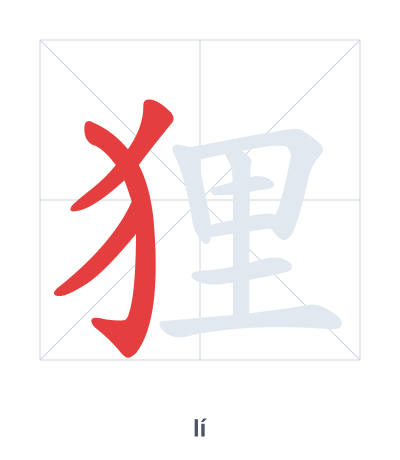
Open Hanzi Writer to see the animated stroke order and practice writing 狸 with real-time feedback.
The character 狸 (lí) is written with 10 strokes. Follow the standard Chinese stroke order: top to bottom, left to right, outside before inside. The radical 犭 is one of its key components.
Practice the correct stroke order with the Hanzi Writer app to see animated stroke-by-stroke guidance with real-time feedback.
狸 means raccoon dog / fox-like animal.
狸 is a compound character combining the animal radical 犭 (dog/beast) with the phonetic component 里 (lǐ, meaning 'village' or 'inside'). The 犭 indicates it's a wild animal, while 里 provides the sound and suggests a creature that lurks around human settlements, like the raccoon dog or fox-like animal.
💡 Memory Tip: Picture a furry raccoon dog peeking out from inside a village (里), its paw (犭) sneaking through a fence.
狐狸很狡猾。
hú lí hěn jiǎo huá
Foxes are very cunning.
狸猫换太子。
lí māo huàn tài zi
Substituting a leopard cat for the crown prince (a legend of deception).
果子狸是野生动物。
guǒ zi lí shì yě shēng dòng wù
The masked palm civet is a wild animal.
Open Hanzi Writer to see the animated stroke order and practice writing 狸 with real-time feedback.
✨ Animated stroke order · Handwriting recognition · HSK-graded practice · Free to use
The left component 犭 is the 'animal' radical, showing this character refers to a type of animal. The right component 里 provides the pronunciation (lí) and can be remembered as 'inside', but its main role is phonetic. Together, 狸 means a raccoon dog or fox-like wild animal.