狐 (hú) means "Fox" in Chinese. It has 8 strokes with the radical 犭.
Rated 3.7/5 in difficulty (challenging).
Appears in 3+ common words including 狐狸 (hú lí), 狐疑 (hú yí), 狐臭 (hú chòu).
Due to its 8 strokes, Hanzi Writer's error detection shows 狐 requires focused practice — most learners need 10+ attempts for consistent accuracy.
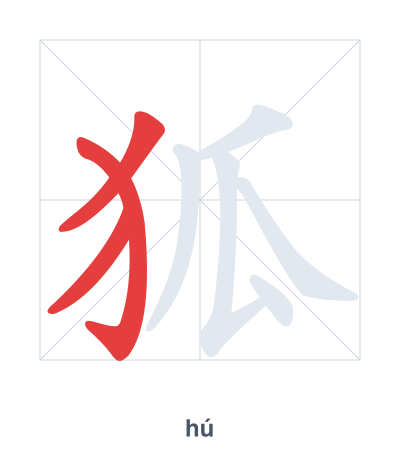
Open Hanzi Writer to see the animated stroke order and practice writing 狐 with real-time feedback.
The character 狐 (hú) is written with 8 strokes. Follow the standard Chinese stroke order: top to bottom, left to right, outside before inside. The radical 犭 is one of its key components.
Practice the correct stroke order with the Hanzi Writer app to see animated stroke-by-stroke guidance with real-time feedback.
狐 means Fox.
This character combines the radical 犭 (beast/dog) with the phonetic component 瓜 (melon), as foxes are clever canine-like creatures. The melon sound element hints at the fox's sneaky nature, evoking the idea of a sly animal that might hide among melons.
💡 Memory Tip: Picture a fox (犭) peeking out from behind a giant melon (瓜) with a cunning grin.
狐狸是一种聪明的动物。
hú lí shì yī zhǒng cōng míng de dòng wù
The fox is a clever animal.
他满脸狐疑地看着我。
tā mǎn liǎn hú yí dì kàn zhe wǒ
He looked at me with a suspicious face.
他身上有一股狐臭味。
tā shēn shàng yǒu yī gǔ hú chòu wèi
He has body odor.
Open Hanzi Writer to see the animated stroke order and practice writing 狐 with real-time feedback.
✨ Animated stroke order · Handwriting recognition · HSK-graded practice · Free to use
The left radical 犭 (dog radical) indicates the character relates to animals, especially wild ones. The right part 瓜 (guā, melon) provides the pronunciation hint hú. Together, they form the character for 'fox'.