蛞 (kuò) means "slug" in Chinese. It has 12 strokes with the radical 虫.
Rated 4.2/5 in difficulty (advanced).
Appears in 3+ common words including 蛞蝓 (kuò yú), 蛞蝓干 (kuò yú gàn), 找蛞蝓 (zhǎo kuò yú).
Due to its 12 strokes, Hanzi Writer's error detection shows 蛞 requires focused practice — most learners need 10+ attempts for consistent accuracy.
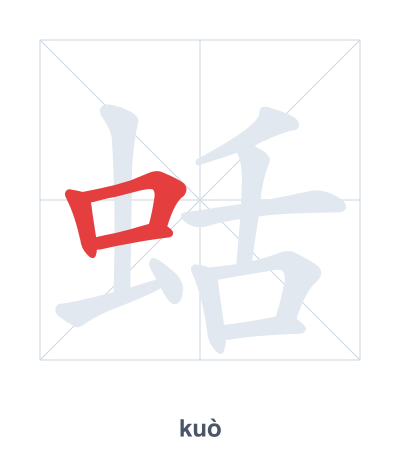
Open Hanzi Writer to see the animated stroke order and practice writing 蛞 with real-time feedback.
The character 蛞 (kuò) is written with 12 strokes. Follow the standard Chinese stroke order: top to bottom, left to right, outside before inside. The radical 虫 is one of its key components.
Practice the correct stroke order with the Hanzi Writer app to see animated stroke-by-stroke guidance with real-time feedback.
蛞 means slug.
蛞 is a phono-semantic compound combining the radical 虫 (insect/creature) and 舌 (tongue), which provides the sound (similar to 括 kuò). The 舌 component also visually suggests the slug's long, slimy, tongue-like body.
💡 Memory Tip: Picture a slug (虫) stretching out its long, wet tongue (舌) to slither along the ground.
蛞蝓爬过留下了痕迹。
kuò yú pá guò liú xià le hén jì
Slugs leave trails behind as they crawl.
蛞蝓干可以入药。
kuò yú gàn kě yǐ rù yào
Dried slugs can be used in medicine.
下雨后能找到蛞蝓。
xià yǔ hòu néng zhǎo dào kuò yú
Slugs can be found after it rains.
Open Hanzi Writer to see the animated stroke order and practice writing 蛞 with real-time feedback.
✨ Animated stroke order · Handwriting recognition · HSK-graded practice · Free to use
蛞 is made of the radical 虫 (insect) on the left and 舌 (tongue) on the right. The insect radical shows it is a small creature, and the right part hints at the shape of a slug, which looks like a slimy tongue. Together they form the character for 'slug'.