隗 (kuí) means "Wei (a surname)" in Chinese. It has 11 strokes with the radical 阝.
Rated 3.9/5 in difficulty (challenging).
Appears in 3+ common words including 姓隗 (xìng kuí), 隗氏 (kuí shì), 隗嚣 (kuí xiāo).
Due to its 11 strokes, Hanzi Writer's error detection shows 隗 requires focused practice — most learners need 10+ attempts for consistent accuracy.
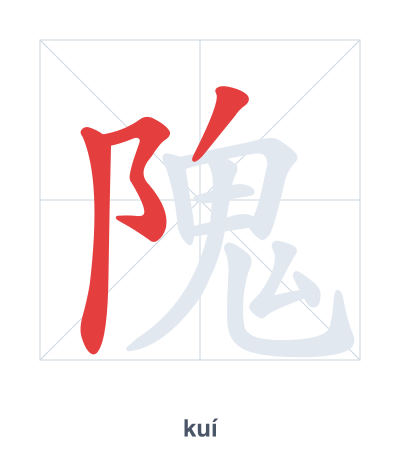
Open Hanzi Writer to see the animated stroke order and practice writing 隗 with real-time feedback.
The character 隗 (kuí) is written with 11 strokes. Follow the standard Chinese stroke order: top to bottom, left to right, outside before inside. The radical 阝 is one of its key components.
Practice the correct stroke order with the Hanzi Writer app to see animated stroke-by-stroke guidance with real-time feedback.
隗 means Wei (a surname).
隗 is a compound character with the left radical 阝 (meaning mound or hill) and the right component 鬼 (ghost). The mound radical indicates a connection to a place or territory, while 鬼 provides phonetic and perhaps semantic hints, possibly relating to a tribal name or spiritual association. Historically, it is used as a surname, most famously for the Han dynasty warlord 隗嚣.
💡 Memory Tip: Picture a ghost (鬼) sitting on a mound (阝) to recall that the surname 隗 (Wei) sounds like 'weird' — because a ghost on a mound is indeed a weird sight.
我的老师姓隗。
wǒ de lǎo shī xìng kuí
My teacher's surname is Wei.
隗氏是一个古老的姓氏。
kuí shì shì yí gè gǔ lǎo de xìng shì
Wei is an ancient surname.
隗嚣是历史上的名人。
kuí xiāo shì lì shǐ shàng de míng rén
Wei Xiao is a famous person in history.
Open Hanzi Writer to see the animated stroke order and practice writing 隗 with real-time feedback.
✨ Animated stroke order · Handwriting recognition · HSK-graded practice · Free to use
隗 is made of the radical 阝 (on the left, meaning "mound" or "place") and the phonetic part 鬼 (meaning "ghost"). The 阝 suggests a place or clan name, while 鬼 provides the sound kuí. Together they form a surname, not a literal place of ghosts.