逵 (kuí) means "thoroughfare" in Chinese. It has 11 strokes with the radical 辶.
Rated 4.2/5 in difficulty (advanced).
Appears in 3+ common words including 李逵 (lǐ kuí), 逵路 (kuí lù), 大逵 (dà kuí).
Due to its 11 strokes, Hanzi Writer's error detection shows 逵 requires focused practice — most learners need 10+ attempts for consistent accuracy.
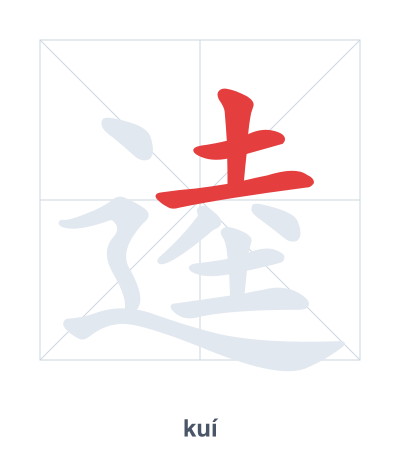
Open Hanzi Writer to see the animated stroke order and practice writing 逵 with real-time feedback.
The character 逵 (kuí) is written with 11 strokes. Follow the standard Chinese stroke order: top to bottom, left to right, outside before inside. The radical 辶 is one of its key components.
Practice the correct stroke order with the Hanzi Writer app to see animated stroke-by-stroke guidance with real-time feedback.
逵 means thoroughfare.
逵 is a phono-semantic compound combining the radical 辶 (movement, as in a path) with 奎 (kuí, meaning 'crotch' or 'stride'), which provides the pronunciation. The character originally referred to a main road or thoroughfare, often one with multiple intersecting paths.
💡 Memory Tip: On the thoroughfare (辶), a giant (大) stands on an earth mound (土) shouting 'Kuí!' to direct traffic at the busy crossroads.
李逵是书里的英雄。
lǐ kuí shì shū lǐ de yīng xióng
Li Kui is a hero in the book.
逵路通向四面八方。
kuí lù tōng xiàng sì miàn bā fāng
The thoroughfare leads in all directions.
我们走在大逵上。
wǒ men zǒu zài dà kuí shàng
We are walking on the main road.
Open Hanzi Writer to see the animated stroke order and practice writing 逵 with real-time feedback.
✨ Animated stroke order · Handwriting recognition · HSK-graded practice · Free to use
The character 逵 is made of the radical 辶 (walk) on the left, which shows movement or a path. The right part provides the sound kuí, and together they suggest a thoroughfare or main road where people walk.