狯 (kuài) means "cunning" in Chinese. It has 9 strokes with the radical 犭.
Rated 4/5 in difficulty (challenging).
Appears in 3+ common words including 狡狯 (jiǎo kuài), 顽狯 (wán kuài), 狯黠 (kuài xiá).
Due to its 9 strokes, Hanzi Writer's error detection shows 狯 requires focused practice — most learners need 10+ attempts for consistent accuracy.
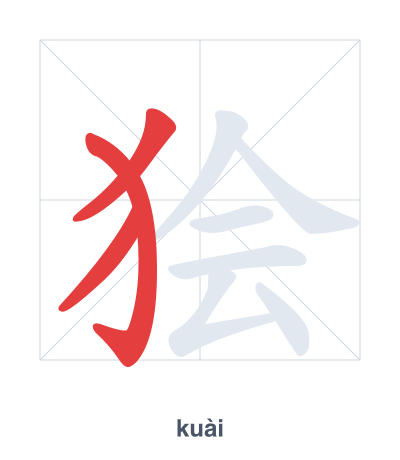
Open Hanzi Writer to see the animated stroke order and practice writing 狯 with real-time feedback.
The character 狯 (kuài) is written with 9 strokes. Follow the standard Chinese stroke order: top to bottom, left to right, outside before inside. The radical 犭 is one of its key components.
Practice the correct stroke order with the Hanzi Writer app to see animated stroke-by-stroke guidance with real-time feedback.
狯 means cunning.
The character 狯 (kuài) is a phono-semantic compound: the left radical 犭 (dog) hints at animal-like slyness, while the right component 会 (huì, meaning 'to meet' or 'can') provides the sound. In ancient usage, a cunning dog was often associated with clever, sneaky behavior.
💡 Memory Tip: Picture a sly dog (犭) sneaking into a meeting (会) and tricking all the other animals.
他为人很狡狯。
tā wéi rén hěn jiǎo kuài
He is very crafty.
这个孩子很顽狯。
zhè ge hái zi hěn wán kuài
This child is very mischievous and playful.
他的眼神很狯黠。
tā de yǎn shén hěn kuài xiá
His gaze is very crafty.
Open Hanzi Writer to see the animated stroke order and practice writing 狯 with real-time feedback.
✨ Animated stroke order · Handwriting recognition · HSK-graded practice · Free to use
狯 is composed of the radical 犭 (dog/animal) on the left and 会 (meeting/able) on the right. The animal radical suggests behavior related to animals, and the right side implies a clever or crafty nature, together forming the meaning 'cunning'.