胯 (kuà) means "hip; crotch" in Chinese. It has 10 strokes with the radical 月.
Rated 4.2/5 in difficulty (advanced).
Appears in 3+ common words including 胯骨 (kuà gǔ), 胯下 (kuà xià), 胯部 (kuà bù).
Due to its 10 strokes, Hanzi Writer's error detection shows 胯 requires focused practice — most learners need 10+ attempts for consistent accuracy.
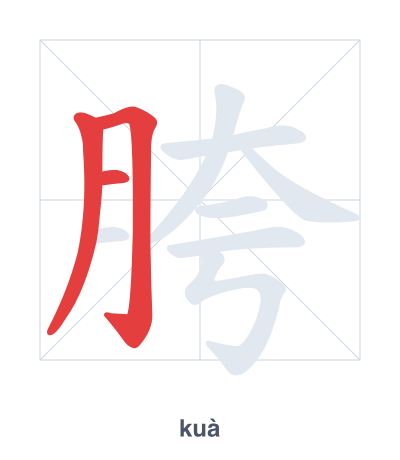
Open Hanzi Writer to see the animated stroke order and practice writing 胯 with real-time feedback.
The character 胯 (kuà) is written with 10 strokes. Follow the standard Chinese stroke order: top to bottom, left to right, outside before inside. The radical 月 is one of its key components.
Practice the correct stroke order with the Hanzi Writer app to see animated stroke-by-stroke guidance with real-time feedback.
胯 means hip; crotch.
The character 胯 is a compound character with the flesh radical 月 (indicating a body part) on the left, and 夸 on the right, which provides the pronunciation kuā. It denotes the hip or crotch area of the body.
💡 Memory Tip: Picture a hip (月) so exaggeratedly wide that it needs a '夸' (exaggeration) to describe it.
摔跤容易伤到胯骨。
shuāi jiāo róng yì shāng dào kuà gǔ
Falling down can easily injure the hip bone.
他从桌子胯下钻了过去。
tā cóng zhuō zi kuà xià zuān le guò qù
He crawled under the table.
运动前要拉伸胯部。
yùn dòng qián yào lā shēn kuà bù
Stretch your hips before exercising.
Open Hanzi Writer to see the animated stroke order and practice writing 胯 with real-time feedback.
✨ Animated stroke order · Handwriting recognition · HSK-graded practice · Free to use
胯 is composed of the radical 月 (the flesh or body part radical) on the left, and the phonetic component 夸 (kuā) on the right. The radical 月 indicates that the character relates to a part of the body, while 夸 provides the approximate pronunciation.