堀 (kū) means "cave; hole; den" in Chinese. It has 11 strokes with the radical 土.
Rated 4.2/5 in difficulty (advanced).
Appears in 3+ common words including 堀室 (kū shì), 堀穴 (kū xué), 龙堀 (lóng kū).
Due to its 11 strokes, Hanzi Writer's error detection shows 堀 requires focused practice — most learners need 10+ attempts for consistent accuracy.
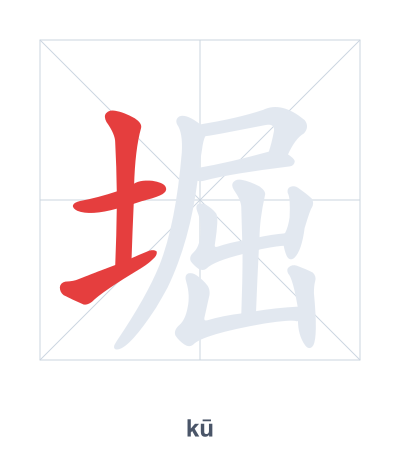
Open Hanzi Writer to see the animated stroke order and practice writing 堀 with real-time feedback.
The character 堀 (kū) is written with 11 strokes. Follow the standard Chinese stroke order: top to bottom, left to right, outside before inside. The radical 土 is one of its key components.
Practice the correct stroke order with the Hanzi Writer app to see animated stroke-by-stroke guidance with real-time feedback.
堀 means cave; hole; den.
堀 is a phono-semantic compound. The radical 土 (earth) indicates the meaning relates to the ground, while 屈 (kū, meaning 'bent' or 'crooked') provides the sound and suggests the shape of a winding cave or hole dug into the earth.
💡 Memory Tip: Picture a bent person (屈) crawling into a hole in the ground (土) — that's a cramped, crooked cave.
这是一个地下堀室。
zhè shì yí gè dì xià kū shì
This is an underground chamber.
小兔子住在堀穴里。
xiǎo tù zi zhù zài kū xué lǐ
The little bunny lives in a burrow.
传说这里有龙堀。
chuán shuō zhè lǐ yǒu lóng kū
Legend says there is a dragon's cave here.
Open Hanzi Writer to see the animated stroke order and practice writing 堀 with real-time feedback.
✨ Animated stroke order · Handwriting recognition · HSK-graded practice · Free to use
堀 is made of two parts: the left side 土 (earth or soil) and the right side 屈 (bend or subdue). The 土 indicates this character relates to the ground, while 屈 contributes to the meaning of a hollow or bent space underground, like a cave or den.