苛 (kē) means "harsh / severe" in Chinese. It has 8 strokes with the radical 艹, and is HSK Level 7.
Rated 3.7/5 in difficulty (challenging).
Harder than 30% of HSK Level 7 characters.
Appears in 3+ common words including 苛刻 (kē kè), 苛求 (kē qiú), 苛责 (kē zé).
Due to its 8 strokes, Hanzi Writer's error detection shows 苛 requires focused practice — most learners need 10+ attempts for consistent accuracy.
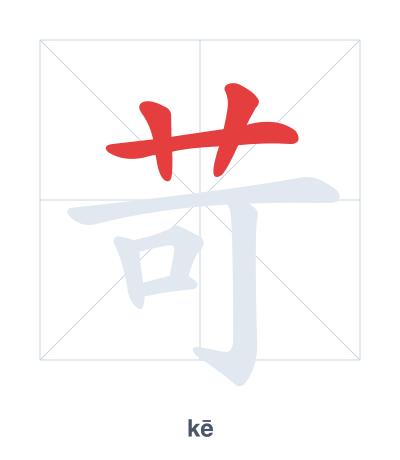
Open Hanzi Writer to see the animated stroke order and practice writing 苛 with real-time feedback.
The character 苛 (kē) is written with 8 strokes. Follow the standard Chinese stroke order: top to bottom, left to right, outside before inside. The radical 艹 is one of its key components.
Practice the correct stroke order with the Hanzi Writer app to see animated stroke-by-stroke guidance with real-time feedback.
苛 means harsh / severe.
As an HSK Level 7 character, 苛 is an intermediate-level character.
The character 苛 combines the radical 艹 (grass) and the phonetic component 可 (kě). Originally it referred to a type of prickly or irritating grass, which led to the extended meaning of 'harsh' or 'severe.'
💡 Memory Tip: Picture a harsh, thorny plant (艹) that warns you, 'I can (可) sting you!'
他的要求很苛刻。
tā de yāo qiú hěn kē kè
His requirements are very demanding.
不要苛求完美。
bú yào kē qiú wán měi
Don't demand perfection.
请不要苛责孩子。
qǐng bú yào kē zé hái zi
Please don't be too hard on the child.
Open Hanzi Writer to see the animated stroke order and practice writing 苛 with real-time feedback.
✨ Animated stroke order · Handwriting recognition · HSK-graded practice · Free to use
The character 苛 has the grass radical 艹 on top and the phonetic component 可 below. While the grass radical suggests a plant origin, the meaning 'harsh' is abstract and not directly tied to the components. The bottom part 可 provides the pronunciation kē.