犂 (lí) means "plow (variant)" in Chinese. It has 13 strokes with the radical 牛.
Rated 4.2/5 in difficulty (advanced).
Appears in 3+ common words including 犂地 (lí dì), 犂刀 (lí dāo), 犂牛 (lí niú).
Due to its 13 strokes, Hanzi Writer's error detection shows 犂 requires focused practice — most learners need 10+ attempts for consistent accuracy.
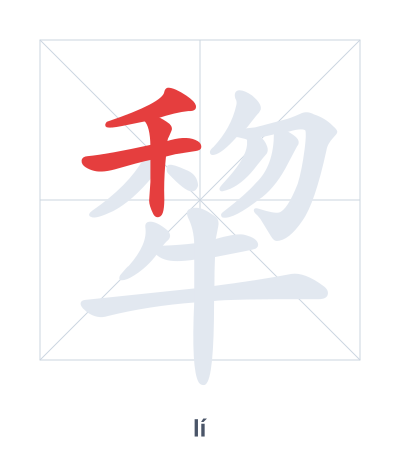
Open Hanzi Writer to see the animated stroke order and practice writing 犂 with real-time feedback.
The character 犂 (lí) is written with 13 strokes. Follow the standard Chinese stroke order: top to bottom, left to right, outside before inside. The radical 牛 is one of its key components.
Practice the correct stroke order with the Hanzi Writer app to see animated stroke-by-stroke guidance with real-time feedback.
犂 means plow (variant).
| Character | 犂 |
| Pinyin | lí (li) |
| Meaning | plow (variant) |
| Strokes | 13 |
| Radical | 牛 |
| Difficulty | 4.2/5 |
犂 combines 牛 (cow/ox) with 利 (sharp, benefit), suggesting the sharp plow blade pulled by an ox to benefit farming.
💡 Memory Tip: A strong ox (牛) pulls a sharp (利) blade through the earth to plow the field.
农夫正在田里犂地。
nóng fū zhèng zài tián lǐ lí dì
The farmer is plowing the field.
这个犂刀非常锋利。
zhè ge lí dāo fēi cháng fēng lì
This plowshare is very sharp.
犂牛在田间工作。
lí niú zài tián jiān gōng zuò
The plow ox is working in the field.
Open Hanzi Writer to see the animated stroke order and practice writing 犂 with real-time feedback.
✨ Animated stroke order · Handwriting recognition · HSK-graded practice · Free to use
犂 is made of two parts: 利 on top and 牛 on the bottom. 利 means "sharp" and 牛 means "ox", so together they suggest a sharp tool pulled by an ox, which is exactly what a plow is.