犊 (dú) means "calf" in Chinese. It has 12 strokes with the radical 牛.
Rated 4.2/5 in difficulty (advanced).
Appears in 3+ common words including 牛犊 (niú dú), 犊子 (dú zi), 初生牛犊 (chū shēng niú dú).
Due to its 12 strokes, Hanzi Writer's error detection shows 犊 requires focused practice — most learners need 10+ attempts for consistent accuracy.
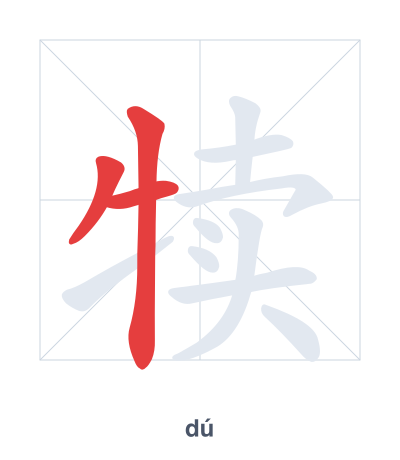
Open Hanzi Writer to see the animated stroke order and practice writing 犊 with real-time feedback.
The character 犊 (dú) is written with 12 strokes. Follow the standard Chinese stroke order: top to bottom, left to right, outside before inside. The radical 牛 is one of its key components.
Practice the correct stroke order with the Hanzi Writer app to see animated stroke-by-stroke guidance with real-time feedback.
犊 means calf.
| Character | 犊 |
| Pinyin | dú (du) |
| Meaning | calf |
| Strokes | 12 |
| Radical | 牛 |
| Difficulty | 4.2/5 |
犊 is a compound character with the radical 牛 (cow) indicating its relation to cattle, and the component 卖 (sell) suggesting a young cow that is often sold at market. It specifically means 'calf'—the young offspring of a cow.
💡 Memory Tip: Picture a tiny calf (犊) wearing a price tag (卖) around its neck, being sold at a farm market.
小牛犊在草地上跑。
xiǎo niú dú zài cǎo dì shàng pǎo
The calf is running on the grass.
这是一头小犊子。
zhè shì yī tóu xiǎo dú zi
This is a small calf.
他像个初生牛犊。
tā xiàng gè chū shēng niú dú
He is like a newborn calf, fearless and bold.
Open Hanzi Writer to see the animated stroke order and practice writing 犊 with real-time feedback.
✨ Animated stroke order · Handwriting recognition · HSK-graded practice · Free to use
The left side of 犊 is the radical 牛 (cow or ox), which shows that the character relates to cattle. The right side is 卖 (to sell), which originally provided a phonetic clue, even though the pronunciation has changed over time. Together, the character means 'calf'—a young cow.