拷 (kǎo) means "to interrogate under torture; to copy" in Chinese. It has 9 strokes with the radical 扌.
Rated 4/5 in difficulty (challenging).
Appears in 3+ common words including 拷贝 (kǎo bèi), 拷问 (kǎo wèn), 拷打 (kǎo dǎ).
Due to its 9 strokes, Hanzi Writer's error detection shows 拷 requires focused practice — most learners need 10+ attempts for consistent accuracy.
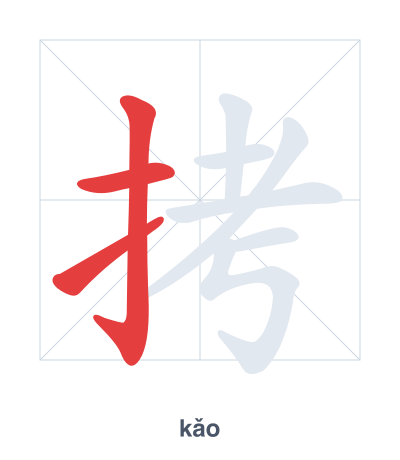
Open Hanzi Writer to see the animated stroke order and practice writing 拷 with real-time feedback.
The character 拷 (kǎo) is written with 9 strokes. Follow the standard Chinese stroke order: top to bottom, left to right, outside before inside. The radical 扌 is one of its key components.
Practice the correct stroke order with the Hanzi Writer app to see animated stroke-by-stroke guidance with real-time feedback.
拷 means to interrogate under torture; to copy.
拷 is a phono-semantic compound: the radical 扌 (hand) suggests an action, while 考 (kǎo) provides the pronunciation. Originally, 考 depicted an old man with a cane, but here it hints at the meaning of 'to beat' or 'to examine harshly,' as in interrogating under torture. Later, the character was borrowed phonetically to mean 'to copy' (as in '拷贝').
💡 Memory Tip: Imagine a torturer's hand (扌) holding a test paper (考) and beating a student for copying—now '拷' means both torture and copy.
请拷贝这个文件。
qǐng kǎo bèi zhè ge wén jiàn
Please copy this file.
他在拷问那个人。
tā zài kǎo wèn nà ge rén
He is interrogating that person.
他受到了拷打。
tā shòu dào le kǎo dǎ
He was tortured.
Open Hanzi Writer to see the animated stroke order and practice writing 拷 with real-time feedback.
✨ Animated stroke order · Handwriting recognition · HSK-graded practice · Free to use
The left side is 扌, the hand radical, indicating the action involves the hand. The right side is 考 (kǎo), which gives the sound and also suggests the idea of 'testing' or 'examining', connecting to torture interrogation. The two parts together show a hand performing an oppressive or copying action.