剞 (jī) means "curved carving tool; to carve" in Chinese. It has 10 strokes with the radical 刂.
Rated 3.9/5 in difficulty (challenging).
Appears in 3+ common words including 剞劂 (jī jué), 剞刻 (jī kè), 剞劙 (jī lí).
Due to its 10 strokes, Hanzi Writer's error detection shows 剞 requires focused practice — most learners need 10+ attempts for consistent accuracy.
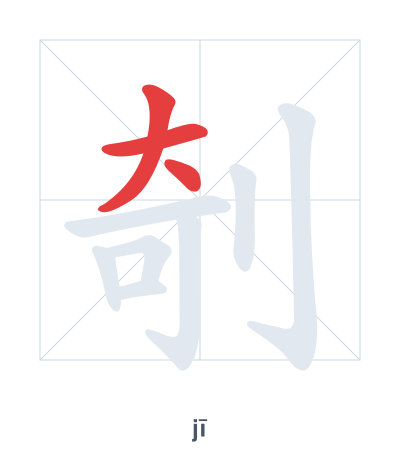
Open Hanzi Writer to see the animated stroke order and practice writing 剞 with real-time feedback.
The character 剞 (jī) is written with 10 strokes. Follow the standard Chinese stroke order: top to bottom, left to right, outside before inside. The radical 刂 is one of its key components.
Practice the correct stroke order with the Hanzi Writer app to see animated stroke-by-stroke guidance with real-time feedback.
剞 means curved carving tool; to carve.
剞 combines the radical 刂 (knife) with the phonetic component 奇 (qí, meaning 'strange' or 'irregular'), which hints at the unusual curved shape of the carving tool. The knife radical emphasizes its function as a cutting implement used in wood or stone carving.
💡 Memory Tip: Imagine a strange (奇) curved knife (刂) that carves zigzag paths through a block of wood.
他精通剞劂之术。
tā jīng tōng jī jué zhī shù
He is proficient in the art of woodblock engraving.
这块木头正在剞刻。
zhè kuài mù tou zhèng zài jī kè
This piece of wood is being carved.
这是一个剞劙工具。
zhè shì yí gè jī lí gōng jù
This is a carving tool.
Open Hanzi Writer to see the animated stroke order and practice writing 剞 with real-time feedback.
✨ Animated stroke order · Handwriting recognition · HSK-graded practice · Free to use
剞 combines the radical 刂 (knife, used for cutting actions) on the right with the component 奇 (qí, meaning "strange" or "uneven") on the left. The left part suggests an irregular or curved shape, and the knife radical indicates the tool used to carve that shape. Together, they represent a curved carving tool and the action of carving.