葛 (gé) means "kudzu / vine" in Chinese. It has 12 strokes with the radical 艹.
Rated 4.2/5 in difficulty (advanced).
Appears in 3+ common words including 葛粉 (gé fěn), 姓葛 (xìng gé), 葛根 (gé gēn).
Due to its 12 strokes, Hanzi Writer's error detection shows 葛 requires focused practice — most learners need 10+ attempts for consistent accuracy.
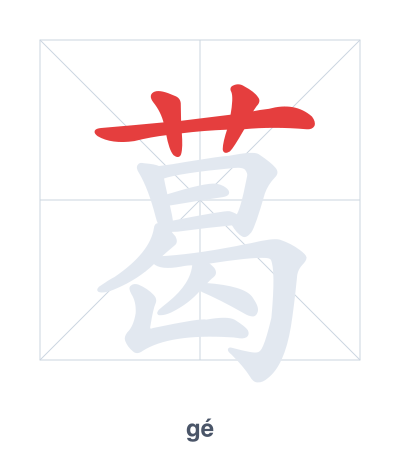
Open Hanzi Writer to see the animated stroke order and practice writing 葛 with real-time feedback.
The character 葛 (gé) is written with 12 strokes. Follow the standard Chinese stroke order: top to bottom, left to right, outside before inside. The radical 艹 is one of its key components.
Practice the correct stroke order with the Hanzi Writer app to see animated stroke-by-stroke guidance with real-time feedback.
葛 means kudzu / vine.
葛 is a phono-semantic compound combining the radical 艹 (grass/plant) with 曷 (hé), which provides the pronunciation. Kudzu is a fast-growing vine belonging to the legume family, hence the plant radical.
💡 Memory Tip: Imagine a kudzu vine (艹) wrapping around a scarecrow that asks 'Huh?' (曷) in surprise as it gets tangled.
葛粉很好喝。
gé fěn hěn hǎo hē
Kudzu powder drink is very tasty.
他姓葛,叫葛平。
tā xìng gé jiào gé píng
His surname is Ge, and his name is Ge Ping.
葛根是中药。
gé gēn shì zhōng yào
Kudzu root is a traditional Chinese medicine.
Open Hanzi Writer to see the animated stroke order and practice writing 葛 with real-time feedback.
✨ Animated stroke order · Handwriting recognition · HSK-graded practice · Free to use
葛 is composed of the grass radical 艹 on top, indicating it is a plant, and the phonetic component 曷 below. The 艹 tells you it belongs to the plant category, specifically kudzu, a climbing vine. The bottom part provides the pronunciation gé.