憬 (jǐng) means "to awaken" in Chinese. It has 15 strokes with the radical 忄.
Rated 4.2/5 in difficulty (advanced).
Appears in 3+ common words including 憧憬 (chōng jǐng), 憬悟 (jǐng wù), 憬然 (jǐng rán).
Due to its 15 strokes, Hanzi Writer's error detection shows 憬 requires focused practice — most learners need 10+ attempts for consistent accuracy.
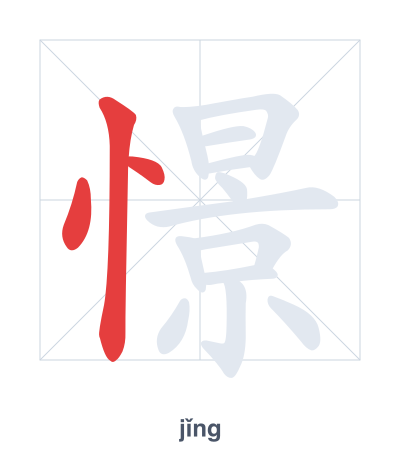
Open Hanzi Writer to see the animated stroke order and practice writing 憬 with real-time feedback.
The character 憬 (jǐng) is written with 15 strokes. Follow the standard Chinese stroke order: top to bottom, left to right, outside before inside. The radical 忄 is one of its key components.
Practice the correct stroke order with the Hanzi Writer app to see animated stroke-by-stroke guidance with real-time feedback.
憬 means to awaken.
憬 combines the heart radical 忄 (mind) with 景 (bright scene/sunlight), suggesting the mind suddenly illuminated—like waking up. It is a phono-semantic compound where 景 hints at brightness and provides the sound jǐng.
💡 Memory Tip: Imagine the sun (日) over a tall building (京) suddenly shining into your heart (忄), jolting you awake.
大家都憧憬着和平。
dà jiā dōu chōng jǐng zhe hé píng
Everyone longs for peace.
他终于憬悟了。
tā zhōng yú jǐng wù le
He finally came to his senses.
他憬然觉悟了。
tā jǐng rán jué wù le
He suddenly came to his senses.
Open Hanzi Writer to see the animated stroke order and practice writing 憬 with real-time feedback.
✨ Animated stroke order · Handwriting recognition · HSK-graded practice · Free to use
憬 is made of the heart radical 忄 on the left and the phonetic component 景 on the right. The heart radical connects to emotions or mental states, while 景 gives the sound jǐng. Together they suggest a mental awakening or sudden realization.