鲸 (jīng) means "Whale" in Chinese. It has 16 strokes with the radical 鱼.
Rated 4.2/5 in difficulty (advanced).
Appears in 3+ common words including 鲸鱼 (jīng yú), 蓝鲸 (lán jīng), 看鲸鱼 (kàn jīng yú).
Due to its 16 strokes, Hanzi Writer's error detection shows 鲸 requires focused practice — most learners need 10+ attempts for consistent accuracy.
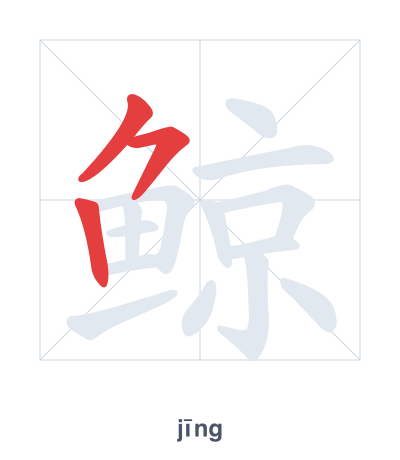
Open Hanzi Writer to see the animated stroke order and practice writing 鲸 with real-time feedback.
The character 鲸 (jīng) is written with 16 strokes. Follow the standard Chinese stroke order: top to bottom, left to right, outside before inside. The radical 鱼 is one of its key components.
Practice the correct stroke order with the Hanzi Writer app to see animated stroke-by-stroke guidance with real-time feedback.
鲸 means Whale.
鲸 is a phono-semantic compound character. The radical 鱼 (fish) indicates it is a marine creature, while the component 京 (jīng) provides phonetic cues. Together they form the word for 'whale,' the largest animal in the sea.
💡 Memory Tip: Picture a giant fish (鱼) that is as enormous as a capital city (京)—that's a whale.
鲸鱼是海洋里最大的动物。
jīng yú shì hǎi yáng lǐ zuì dà de dòng wù
Whales are the largest animals in the ocean.
蓝鲸的身体非常长。
lán jīng de shēn tǐ fēi cháng zhǎng
The blue whale's body is very long.
我们坐船去海上看鲸鱼。
wǒ men zuò chuán qù hǎi shàng kàn jīng yú
We go by boat to see whales at sea.
Open Hanzi Writer to see the animated stroke order and practice writing 鲸 with real-time feedback.
✨ Animated stroke order · Handwriting recognition · HSK-graded practice · Free to use
鲸 is made of the radical 鱼 (fish) on the left and the phonetic component 京 (jīng) on the right. The radical tells you it is a type of fish or sea creature, and the right side gives the pronunciation. Although whales are mammals, in Chinese they are grouped with fish characters due to their aquatic habitat.