恝 (jiá) means "indifferent" in Chinese. It has 10 strokes with the radical 心.
Rated 4.2/5 in difficulty (advanced).
Appears in 3+ common words including 恝然 (jiá rán), 恝置 (jiá zhì), 恝情 (jiá qíng).
Due to its 10 strokes, Hanzi Writer's error detection shows 恝 requires focused practice — most learners need 10+ attempts for consistent accuracy.
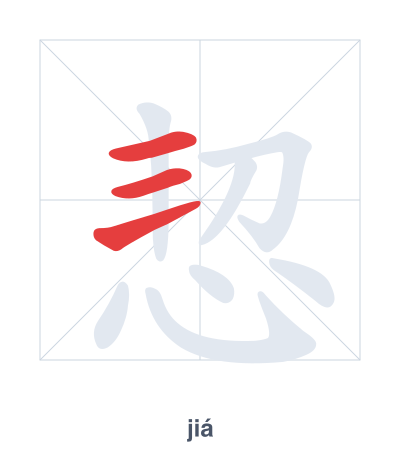
Open Hanzi Writer to see the animated stroke order and practice writing 恝 with real-time feedback.
The character 恝 (jiá) is written with 10 strokes. Follow the standard Chinese stroke order: top to bottom, left to right, outside before inside. The radical 心 is one of its key components.
Practice the correct stroke order with the Hanzi Writer app to see animated stroke-by-stroke guidance with real-time feedback.
恝 means indifferent.
恝 combines a claw (㕚) over the heart radical (心), suggesting a heart that is tightly grasped or hardened, leading to emotional numbness or indifference.
💡 Memory Tip: Imagine a claw grabbing your heart so tightly that you feel nothing—completely indifferent.
他表现得很恝然。
tā biǎo xiàn dé hěn jiá rán
He acted very indifferently.
对此不可恝置。
duì cǐ bù kě jiá zhì
This cannot be ignored or neglected.
他的态度很恝情。
tā de tài dù hěn jiá qíng
His attitude is indifferent and unconcerned.
Open Hanzi Writer to see the animated stroke order and practice writing 恝 with real-time feedback.
✨ Animated stroke order · Handwriting recognition · HSK-graded practice · Free to use
The character 恝 combines the component 加 (jiā, meaning 'to add') on top with the radical 心 (xīn, meaning 'heart') below. The top part gives a phonetic hint for the pronunciation jiá, while the heart radical suggests the meaning relates to a state of mind. Together, they convey the idea of a heart that is 'added' or removed from emotional engagement, leading to the meaning of indifference.