骁 (xiāo) means "brave; valiant; excellent horse" in Chinese. It has 9 strokes with the radical 马.
Rated 4/5 in difficulty (challenging).
Appears in 3+ common words including 骁勇 (xiāo yǒng), 骁将 (xiāo jiàng), 骁骑 (xiāo qí).
Due to its 9 strokes, Hanzi Writer's error detection shows 骁 requires focused practice — most learners need 10+ attempts for consistent accuracy.
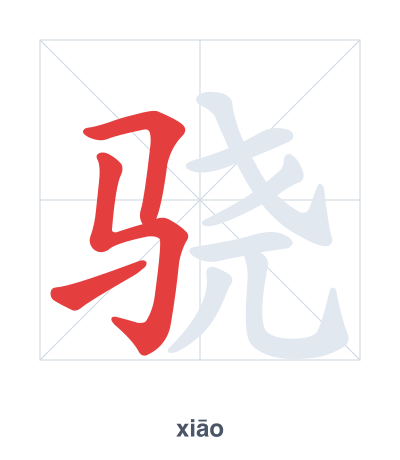
Open Hanzi Writer to see the animated stroke order and practice writing 骁 with real-time feedback.
The character 骁 (xiāo) is written with 9 strokes. Follow the standard Chinese stroke order: top to bottom, left to right, outside before inside. The radical 马 is one of its key components.
Practice the correct stroke order with the Hanzi Writer app to see animated stroke-by-stroke guidance with real-time feedback.
骁 means brave; valiant; excellent horse.
骁 is a phono-semantic compound: the radical 马 (horse) indicates the meaning relates to horses, while 尧 (yáo) provides the sound and also suggests 'lofty' or 'excellent' (from its ancient form depicting a tall person). Together, they evoke a horse of superior quality, hence 'brave' or 'valiant', and later extended to describe heroic warriors.
💡 Memory Tip: Visualize a valiant horse (马) leaping over three towering peaks (the top part of 尧) to prove its bravery.
他是一个骁勇的战士。
tā shì yí gè xiāo yǒng de zhàn shì
He is a brave and valiant warrior.
他是队里的一员骁将。
tā shì duì lǐ de yī yuán xiāo jiàng
He is a valiant fighter on the team.
骁骑营在古代很有名。
xiāo qí yíng zài gǔ dài hěn yǒu míng
The Elite Cavalry Battalion was very famous in ancient times.
Open Hanzi Writer to see the animated stroke order and practice writing 骁 with real-time feedback.
✨ Animated stroke order · Handwriting recognition · HSK-graded practice · Free to use
骁 is composed of the radical 马 (horse) on the left and 尧 (yáo) on the right. The horse radical connects to the original meaning of an excellent horse, which extended to describe bravery in battle. The right part 尧 provides the pronunciation xiāo but does not directly contribute to the meaning.