戟 (jǐ) means "Halberd (an ancient weapon)." in Chinese. It has 12 strokes with the radical 戈.
Rated 4.2/5 in difficulty (advanced).
Appears in 3+ common words including 方天戟 (fāng tiān jǐ), 戈戟 (gē jǐ), 戟手 (jǐ shǒu).
Due to its 12 strokes, Hanzi Writer's error detection shows 戟 requires focused practice — most learners need 10+ attempts for consistent accuracy.
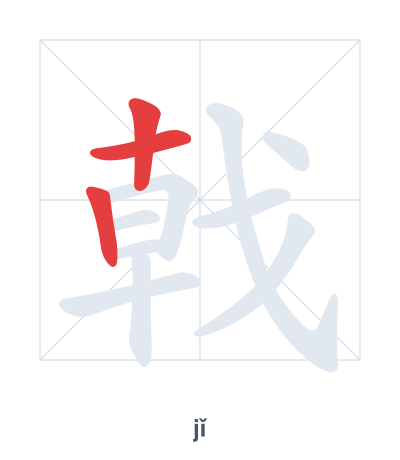
Open Hanzi Writer to see the animated stroke order and practice writing 戟 with real-time feedback.
The character 戟 (jǐ) is written with 12 strokes. Follow the standard Chinese stroke order: top to bottom, left to right, outside before inside. The radical 戈 is one of its key components.
Practice the correct stroke order with the Hanzi Writer app to see animated stroke-by-stroke guidance with real-time feedback.
戟 means Halberd (an ancient weapon)..
戟 is a compound character combining the weapon radical 戈 (spear/halberd) with the component 卓, which originally depicted a tall pole or standing figure—together they represent a halberd, a long-shafted weapon with a blade and spike. In ancient forms, the left side suggested the elongated shaft while the right side showed the weapon head.
💡 Memory Tip: Picture a warrior standing tall (卓) on a platform, thrusting a spear (戈) as a deadly halberd (戟).
他拿着一把方天戟。
tā ná zhe yī bǎ fāng tiān jǐ
He was holding a double-bladed halberd.
古代士兵使用戈戟。
gǔ dài shì bīng shǐ yòng gē jǐ
Ancient soldiers used dagger-axes and halberds.
他戟手大骂那个人。
tā jǐ shǒu dà mà nà ge rén
He pointed his finger and cursed that person angrily.
Open Hanzi Writer to see the animated stroke order and practice writing 戟 with real-time feedback.
✨ Animated stroke order · Handwriting recognition · HSK-graded practice · Free to use
戟 combines the radical 戈 (gē, "spear/weapon") on the right with a left component 卓 (zhuō, "table/tall"). The 戈 radical directly indicates it is a weapon, while 卓 may suggest the long shaft of a halberd. This structure visually represents a long-handled weapon with a pointed blade and axe-like edge.