戛 (jiá) means "To tap; to clatter; a sudden stop." in Chinese. It has 11 strokes with the radical 戈.
Rated 4.2/5 in difficulty (advanced).
Appears in 3+ common words including 戛然而止 (jiá rán ér zhǐ), 戛戛 (jiá jiá), 戛玉 (jiá yù).
Due to its 11 strokes, Hanzi Writer's error detection shows 戛 requires focused practice — most learners need 10+ attempts for consistent accuracy.
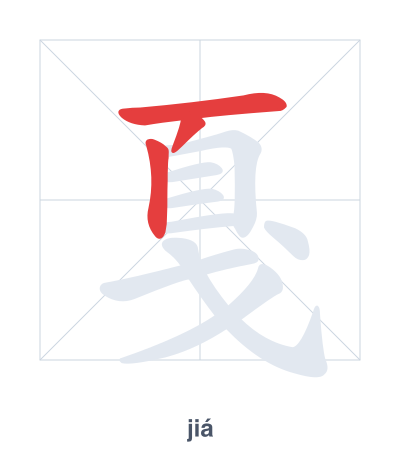
Open Hanzi Writer to see the animated stroke order and practice writing 戛 with real-time feedback.
The character 戛 (jiá) is written with 11 strokes. Follow the standard Chinese stroke order: top to bottom, left to right, outside before inside. The radical 戈 is one of its key components.
Practice the correct stroke order with the Hanzi Writer app to see animated stroke-by-stroke guidance with real-time feedback.
戛 means To tap; to clatter; a sudden stop..
戛 combines 戈 (halberd) with a top component that resembles a hand or striking tool, depicting the action of tapping or abruptly stopping with a clatter. The character's visual form suggests a weapon hitting a surface, producing a sharp sound and sudden halt.
💡 Memory Tip: Picture a warrior (戈) suddenly halting mid-strike, tapping his spear on the ground and shouting 'Jia!' as everything freezes.
音乐戛然而止。
yīn yuè jiá rán ér zhǐ
The music stopped abruptly.
声音戛戛作响。
shēng yīn jiá jiá zuò xiǎng
The sound is clattering or scraping.
声音清脆如戛玉。
shēng yīn qīng cuì rú jiá yù
The sound is as crisp as striking jade.
Open Hanzi Writer to see the animated stroke order and practice writing 戛 with real-time feedback.
✨ Animated stroke order · Handwriting recognition · HSK-graded practice · Free to use
戛 is composed of 戈 (a spear or weapon) on top and 廾 (two hands) below. Together they suggest the action of two hands holding a weapon to tap or strike something. This structure gives the character meanings like "to tap" or "to make a clattering sound."