戜 (dié) means "Sharp; to cut." in Chinese. It has 11 strokes with the radical 戈.
Rated 4.2/5 in difficulty (advanced).
Appears in 3+ common words including 戜戜 (dié dié), 戜然 (dié rán), 戜戜然 (dié dié rán).
Due to its 11 strokes, Hanzi Writer's error detection shows 戜 requires focused practice — most learners need 10+ attempts for consistent accuracy.
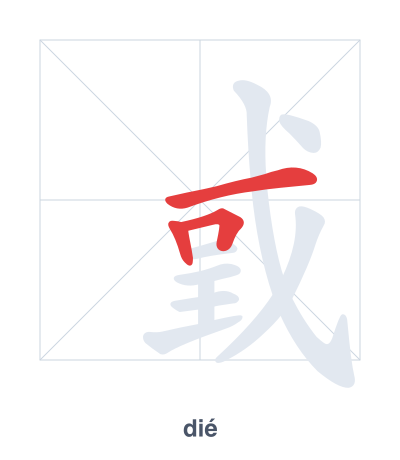
Open Hanzi Writer to see the animated stroke order and practice writing 戜 with real-time feedback.
The character 戜 (dié) is written with 11 strokes. Follow the standard Chinese stroke order: top to bottom, left to right, outside before inside. The radical 戈 is one of its key components.
Practice the correct stroke order with the Hanzi Writer app to see animated stroke-by-stroke guidance with real-time feedback.
戜 means Sharp; to cut..
戜 combines the radical 戈 (spear/weapon) with a left component depicting a sharp blade or point, visually emphasizing the idea of sharpness and cutting. The weapon element directly conveys the act of cutting, while the left side adds the notion of a fine edge.
💡 Memory Tip: Imagine a spear (戈) slicing through a helmet (冖) and a sun (日) — that's one sharp cut!
他的样子很戜戜。
tā de yàng zi hěn dié dié
He looks strong and robust.
戜然有声。
dié rán yǒu shēng
Making a sharp, clear sound.
戜戜然很有礼貌。
dié dié rán hěn yǒu lǐ mào
Behaving in a very polite and orderly manner.
Open Hanzi Writer to see the animated stroke order and practice writing 戜 with real-time feedback.
✨ Animated stroke order · Handwriting recognition · HSK-graded practice · Free to use
The character 戜 is made of two weapon-like components: the left part is 戉 (a broad axe) and the right part is 戈 (a spear). Both are sharp, cutting tools, which together reinforce the meaning of "sharp" or "to cut."