姫 (jī) means "lady; princess (often used in Japanese contexts)" in Chinese. It has 9 strokes with the radical 女.
Rated 4/5 in difficulty (challenging).
Appears in 3+ common words including 姫路 (jī lù), 姫君 (jī jūn), 舞姫 (wǔ jī).
Due to its 9 strokes, Hanzi Writer's error detection shows 姫 requires focused practice — most learners need 10+ attempts for consistent accuracy.
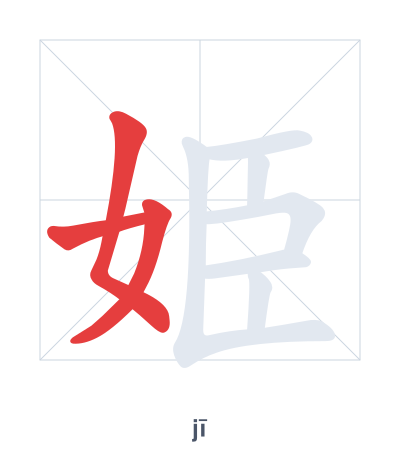
Open Hanzi Writer to see the animated stroke order and practice writing 姫 with real-time feedback.
The character 姫 (jī) is written with 9 strokes. Follow the standard Chinese stroke order: top to bottom, left to right, outside before inside. The radical 女 is one of its key components.
Practice the correct stroke order with the Hanzi Writer app to see animated stroke-by-stroke guidance with real-time feedback.
姫 means lady; princess (often used in Japanese contexts).
姫 is a compound character: the radical 女 (woman) indicates femininity, while the right side 臣 (minister/official) suggests a woman of high status served by ministers. In ancient usage, it referred to noble ladies, and in Japanese contexts it specifically means 'princess' (hime).
💡 Memory Tip: Imagine a woman (女) attended by a kneeling minister (臣) — she is clearly a princess of high rank.
姫路城在日本很有名。
jī lù chéng zài rì běn hěn yǒu míng
Himeji Castle is very famous in Japan.
她是一位高贵的姫君。
tā shì yī wèi gāo guì de jī jūn
She is a noble lady.
舞台上有位美丽的舞姫。
wǔ tái shàng yǒu wèi měi lì de wǔ jī
There is a beautiful female dancer on the stage.
Open Hanzi Writer to see the animated stroke order and practice writing 姫 with real-time feedback.
✨ Animated stroke order · Handwriting recognition · HSK-graded practice · Free to use
The character 姫 is made of the radical 女 (woman) on the left and a right component that resembles 臣 (vassal or official). Together, they suggest a woman of noble status, such as a lady or princess, because the right part indicates service or courtly connection.