诨 (hùn) means "jest" in Chinese. It has 8 strokes with the radical 讠.
Rated 3.4/5 in difficulty (challenging).
Appears in 3+ common words including 诨名 (hùn míng), 打诨 (dǎ hùn), 诨号 (hùn hào).
Due to its 8 strokes, Hanzi Writer's error detection shows 诨 requires focused practice — most learners need 10+ attempts for consistent accuracy.
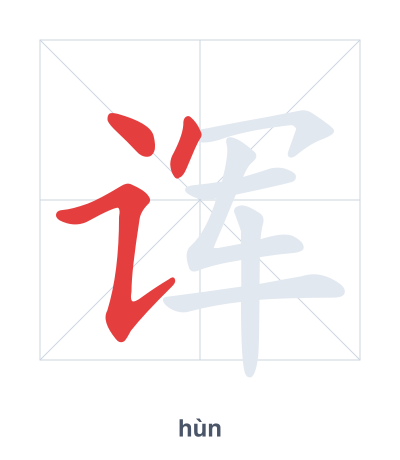
Open Hanzi Writer to see the animated stroke order and practice writing 诨 with real-time feedback.
The character 诨 (hùn) is written with 8 strokes. Follow the standard Chinese stroke order: top to bottom, left to right, outside before inside. The radical 讠 is one of its key components.
Practice the correct stroke order with the Hanzi Writer app to see animated stroke-by-stroke guidance with real-time feedback.
诨 means jest.
This character is a phono-semantic compound: the radical 讠 (speech) indicates joking talk, while 军 (army) provides a phonetic hint (though the pronunciation shifted to hùn). Its meaning 'jest' likely evolved from the playful, teasing banter common among soldiers in a military camp.
💡 Memory Tip: Imagine a soldier (军, like a military vehicle) cracking a silly joke with the speech radical (讠) — that jest is a 诨.
他有一个有趣的诨名。
tā yǒu yí gè yǒu qù de hùn míng
He has a funny nickname.
他喜欢插科打诨。
tā xǐ huān chā kē dǎ hùn
He likes to crack jokes and make witty remarks.
你的诨号是什么?
nǐ de hùn hào shì shén me
What is your nickname?
Open Hanzi Writer to see the animated stroke order and practice writing 诨 with real-time feedback.
✨ Animated stroke order · Handwriting recognition · HSK-graded practice · Free to use
The left side is the radical 讠, meaning "speech" or "language." The right side is 军 (jūn, military), which gives the character its pronunciation hùn. Together, the character suggests speech that is playful or jesting, like joking around.