秽 (huì) means "dirty; filthy; obscene" in Chinese. It has 11 strokes with the radical 禾, and is HSK Level 7.
Rated 4.2/5 in difficulty (advanced).
Harder than 76% of HSK Level 7 characters.
Appears in 3+ common words including 污秽 (wū huì), 秽气 (huì qì), 秽土 (huì tǔ).
Due to its 11 strokes, Hanzi Writer's error detection shows 秽 requires focused practice — most learners need 10+ attempts for consistent accuracy.
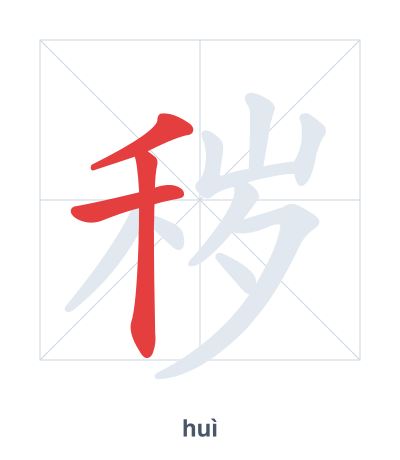
Open Hanzi Writer to see the animated stroke order and practice writing 秽 with real-time feedback.
The character 秽 (huì) is written with 11 strokes. Follow the standard Chinese stroke order: top to bottom, left to right, outside before inside. The radical 禾 is one of its key components.
Practice the correct stroke order with the Hanzi Writer app to see animated stroke-by-stroke guidance with real-time feedback.
秽 means dirty; filthy; obscene.
As an HSK Level 7 character, 秽 is an intermediate-level character.
It combines the radical 禾 (grain) with 歲 (year), originally depicting a field overgrown with weeds after a year's neglect, hence 'dirty' or 'filthy'.
💡 Memory Tip: Imagine grain (禾) left rotting for a year (歲) turning into a filthy, stinking mess.
这里到处是污秽。
zhè lǐ dào chù shì wū huì
There is filth everywhere here.
屋子里有秽气。
wū zi lǐ yǒu huì qì
There is a foul smell in the room.
地上有许多秽土。
dì shàng yǒu xǔ duō huì tǔ
There is a lot of dirty soil on the ground.
Open Hanzi Writer to see the animated stroke order and practice writing 秽 with real-time feedback.
✨ Animated stroke order · Handwriting recognition · HSK-graded practice · Free to use
The character 秽 has the radical 禾 (grain) on the left and 岁 (year) on the right. The grain radical suggests a connection to plants or farming, while 岁 (year) hints at the passage of time. Together they evoke the image of plants left for a year becoming overgrown and filthy, which matches the meaning "dirty" or "filthy".