喙 (huì) means "beak / bill" in Chinese. It has 12 strokes with the radical 口.
Rated 4.2/5 in difficulty (advanced).
Appears in 3+ common words including 鸟喙 (niǎo huì), 长喙 (zhǎng huì), 尖喙 (jiān huì).
Due to its 12 strokes, Hanzi Writer's error detection shows 喙 requires focused practice — most learners need 10+ attempts for consistent accuracy.
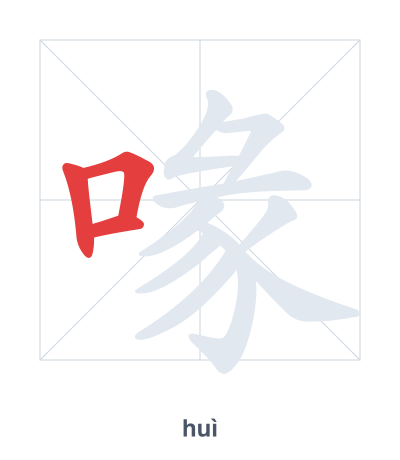
Open Hanzi Writer to see the animated stroke order and practice writing 喙 with real-time feedback.
The character 喙 (huì) is written with 12 strokes. Follow the standard Chinese stroke order: top to bottom, left to right, outside before inside. The radical 口 is one of its key components.
Practice the correct stroke order with the Hanzi Writer app to see animated stroke-by-stroke guidance with real-time feedback.
喙 means beak / bill.
喙 combines the radical 口 (mouth) with 彖, which originally depicted a pig's snout or a severed snout, reinforcing the idea of a projecting mouth part. The character thus signifies a beak or bill of a bird.
💡 Memory Tip: Imagine a bird whose beak (口) is as distinctive as a pig's snout (彖), giving it a unique 'pig-beak.'
鸟喙非常坚硬。
niǎo huì fēi cháng jiān yìng
The bird's beak is very hard.
这种鸟有长喙。
zhè zhǒng niǎo yǒu zhǎng huì
This kind of bird has a long beak.
它的尖喙很有力。
tā de jiān huì hěn yǒu lì
Its sharp beak is very powerful.
Open Hanzi Writer to see the animated stroke order and practice writing 喙 with real-time feedback.
✨ Animated stroke order · Handwriting recognition · HSK-graded practice · Free to use
喙 is composed of the radical 口 (mouth) on the left, indicating the meaning is related to the mouth or oral area. The right part 彖 originally depicted an animal's snout, so together they represent a beak or bill, which is a bird's mouth-like feature.