衙 (yá) means "government office (ancient)" in Chinese. It has 13 strokes with the radical 行.
Rated 4.2/5 in difficulty (advanced).
Appears in 3+ common words including 衙门 (yá mén), 官衙 (guān yá), 衙役 (yá yì).
Due to its 13 strokes, Hanzi Writer's error detection shows 衙 requires focused practice — most learners need 10+ attempts for consistent accuracy.
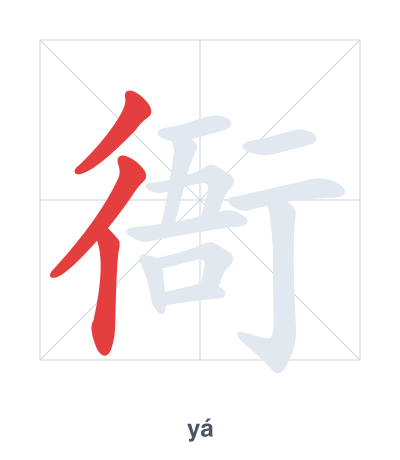
Open Hanzi Writer to see the animated stroke order and practice writing 衙 with real-time feedback.
The character 衙 (yá) is written with 13 strokes. Follow the standard Chinese stroke order: top to bottom, left to right, outside before inside. The radical 行 is one of its key components.
Practice the correct stroke order with the Hanzi Writer app to see animated stroke-by-stroke guidance with real-time feedback.
衙 means government office (ancient).
| Character | 衙 |
| Pinyin | yá (ya) |
| Meaning | government office (ancient) |
| Strokes | 13 |
| Radical | 行 |
| Difficulty | 4.2/5 |
衙 is a compound character. The left side 彳 (a variant of 行 meaning 'walk' or 'movement') combines with 吾 (wú, 'I' or 'my'), which also provides the sound. Together, the character depicts a place where officials walk and act on 'my' (the ruler's) authority, hence an ancient government office or yamen.
💡 Memory Tip: Picture a bureaucrat walking (彳) into the government office and declaring '吾 (I) am in charge here!' as he enters through the gate-like radical 行.
衙门的门很大。
yá mén de mén hěn dà
The gate of the yamen is very large.
这是古代的官衙。
zhè shì gǔ dài de guān yá
This is an ancient government office.
衙役在门口站着。
yá yì zài mén kǒu zhàn zhe
The yamen runner is standing at the door.
Open Hanzi Writer to see the animated stroke order and practice writing 衙 with real-time feedback.
✨ Animated stroke order · Handwriting recognition · HSK-graded practice · Free to use
衙 is composed of the radical 行 (meaning 'to walk' or 'go') on the outside, and the phonetic component 吾 (wú, meaning 'I' or 'my') inside. The radical 行 hints at the idea of a place where people move or gather, which fits a government office. Together, the structure suggests 'a place where officials conduct business,' i.e., a yamen.