颔 (hàn) means "chin / to nod" in Chinese. It has 13 strokes with the radical 页.
Rated 4.2/5 in difficulty (advanced).
Appears in 3+ common words including 颔首 (hàn shǒu), 下颔 (xià hàn), 颔联 (hàn lián).
Due to its 13 strokes, Hanzi Writer's error detection shows 颔 requires focused practice — most learners need 10+ attempts for consistent accuracy.
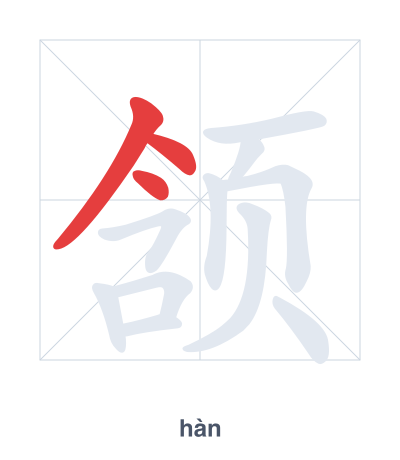
Open Hanzi Writer to see the animated stroke order and practice writing 颔 with real-time feedback.
The character 颔 (hàn) is written with 13 strokes. Follow the standard Chinese stroke order: top to bottom, left to right, outside before inside. The radical 页 is one of its key components.
Practice the correct stroke order with the Hanzi Writer app to see animated stroke-by-stroke guidance with real-time feedback.
颔 means chin / to nod.
颔 combines the radical 页 (head) with 含 (to hold in the mouth), suggesting the chin area where the mouth and head meet. This matches its meaning of 'chin' and the nodding action that involves the chin moving down.
💡 Memory Tip: Picture a head (页) holding a tiny ball (含) in its mouth, and as it nods, the ball bounces off its chin.
他向我颔首示意。
tā xiàng wǒ hàn shǒu shì yì
He nodded to me in greeting.
他的下颔骨很宽。
tā de xià hàn gǔ hěn kuān
His jawbone is very wide.
这首诗的颔联写得好。
zhè shǒu shī de hàn lián xiě dé hǎo
The second couplet of this poem is well-written.
Open Hanzi Writer to see the animated stroke order and practice writing 颔 with real-time feedback.
✨ Animated stroke order · Handwriting recognition · HSK-graded practice · Free to use
颔 is made of 含 (hán, to hold in mouth) on top and 页 (yè, page or head) on the bottom. The radical 页 connects to the head or neck area, while 含 suggests the jaw holding something, together indicating the chin or the nodding motion.