孩 (hái) means "Child." in Chinese. It has 9 strokes with the radical 子, and is HSK Level 1.
Rated 3.5/5 in difficulty (challenging).
Harder than 77% of HSK Level 1 characters.
Appears in 3+ common words including 孩子 (hái zi), 男孩 (nán hái), 女孩 (nǚ hái).
Due to its 9 strokes, Hanzi Writer's error detection shows 孩 requires focused practice — most learners need 10+ attempts for consistent accuracy.
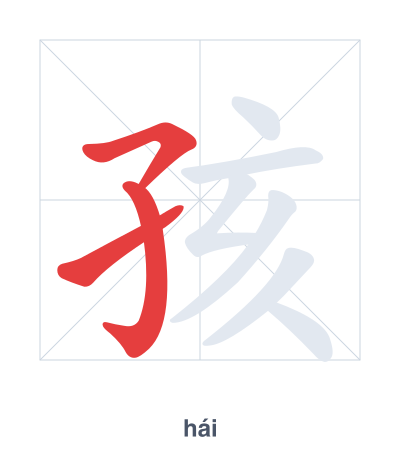
Open Hanzi Writer to see the animated stroke order and practice writing 孩 with real-time feedback.
The character 孩 (hái) is written with 9 strokes. Follow the standard Chinese stroke order: top to bottom, left to right, outside before inside. The radical 子 is one of its key components.
Practice the correct stroke order with the Hanzi Writer app to see animated stroke-by-stroke guidance with real-time feedback.
孩 means Child..
As an HSK Level 1 character, 孩 is among the first characters beginners learn.
The character 孩 is a phono-semantic compound. Its radical 子 (child) directly indicates meaning, while the component 亥 (hài) provides the phonetic hint for pronunciation.
💡 Memory Tip: Picture a child (子) making a funny face like a pig (亥) to remember a playful kid.
那个孩子很可爱。
nà ge hái zi hěn kě ài
That child is very cute.
他是一个小男孩。
tā shì yí gè xiǎo nán hái
He is a little boy.
那个女孩在唱歌。
nà ge nǚ hái zài chàng gē
That girl is singing.
Open Hanzi Writer to see the animated stroke order and practice writing 孩 with real-time feedback.
✨ Animated stroke order · Handwriting recognition · HSK-graded practice · Free to use
The character 孩 is made of the radical 子 on the left, which means 'child' and directly indicates the meaning. The right part is 亥, which provides the pronunciation 'hái' and does not contribute to the meaning. Together, 孩 means 'child'.