蜾 (guǒ) means "Solitary wasp" in Chinese. It has 14 strokes with the radical 虫.
Rated 4.2/5 in difficulty (advanced).
Appears in 3+ common words including 蜾蠃 (guǒ luǒ), 蜾蠃蜂 (guǒ luǒ fēng), 蜾虫 (guǒ chóng).
Due to its 14 strokes, Hanzi Writer's error detection shows 蜾 requires focused practice — most learners need 10+ attempts for consistent accuracy.
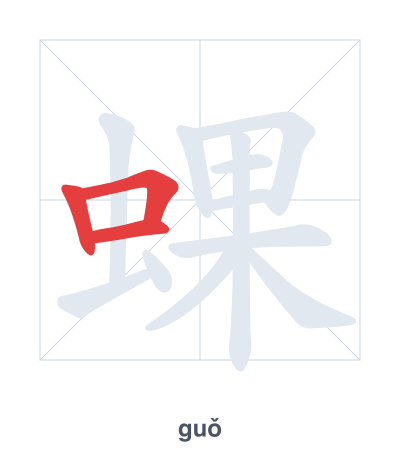
Open Hanzi Writer to see the animated stroke order and practice writing 蜾 with real-time feedback.
The character 蜾 (guǒ) is written with 14 strokes. Follow the standard Chinese stroke order: top to bottom, left to right, outside before inside. The radical 虫 is one of its key components.
Practice the correct stroke order with the Hanzi Writer app to see animated stroke-by-stroke guidance with real-time feedback.
蜾 means Solitary wasp.
蜾 is a phono-semantic compound combining the radical 虫 (chóng, 'insect') with the phonetic component 果 (guǒ, 'fruit'). The radical indicates that it belongs to the insect category, while the sound comes from 果. This character specifically refers to the solitary wasp, a type of insect that often builds its nest in fruit or tree cavities.
💡 Memory Tip: Picture a solitary wasp (虫) sitting on a fruit (果), fiercely guarding its nest.
蜾蠃在树上筑巢。
guǒ luǒ zài shù shàng zhù cháo
The solitary wasp is building a nest in the tree.
蜾蠃蜂是益虫。
guǒ luǒ fēng shì yì chóng
Solitary wasps are beneficial insects.
这种蜾虫很小。
zhè zhǒng guǒ chóng hěn xiǎo
This potter wasp is very small.
Open Hanzi Writer to see the animated stroke order and practice writing 蜾 with real-time feedback.
✨ Animated stroke order · Handwriting recognition · HSK-graded practice · Free to use
The character 蜾 is made of two parts: the left side 虫 (insect radical) and the right side 果 (fruit). The radical 虫 tells you the character refers to an insect, and the phonetic component 果 gives the pronunciation guǒ. Together they represent the solitary wasp, which is a type of insect.