嶡 (guì) means "high and steep" in Chinese. It has 15 strokes with the radical 山.
Rated 4.2/5 in difficulty (advanced).
Appears in 3+ common words including 嶡山 (guì shān), 嶡突 (guì tū), 嶡然 (guì rán).
Due to its 15 strokes, Hanzi Writer's error detection shows 嶡 requires focused practice — most learners need 10+ attempts for consistent accuracy.
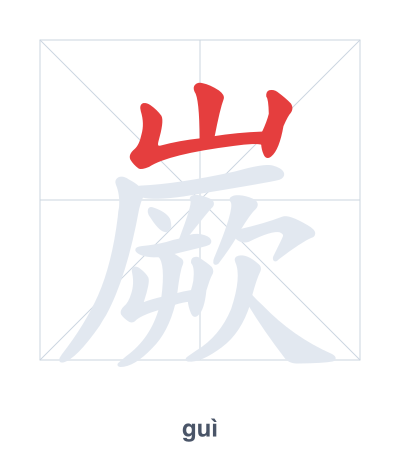
Open Hanzi Writer to see the animated stroke order and practice writing 嶡 with real-time feedback.
The character 嶡 (guì) is written with 15 strokes. Follow the standard Chinese stroke order: top to bottom, left to right, outside before inside. The radical 山 is one of its key components.
Practice the correct stroke order with the Hanzi Writer app to see animated stroke-by-stroke guidance with real-time feedback.
嶡 means high and steep.
嶡 combines the radical 山 (mountain) with 厥, which originally depicted a steep cliff under a precipice. Together, they emphasize a mountain that is extremely high and sheer, evoking a sense of towering, dangerous steepness.
💡 Memory Tip: Imagine climbing a mountain (山) so steep that you faint (厥) from vertigo before reaching the top.
嶡山是一座古老的大山。
guì shān shì yī zuò gǔ lǎo de dà shān
Jueshan is an ancient mountain.
山峰嶡突,直插云霄。
shān fēng guì tū zhí chā yún xiāo
The mountain peaks are steep and jutting, piercing the clouds.
奇峰嶡然挺立在前方。
qí fēng guì rán tǐng lì zài qián fāng
A strange peak stands tall and upright ahead.
Open Hanzi Writer to see the animated stroke order and practice writing 嶡 with real-time feedback.
✨ Animated stroke order · Handwriting recognition · HSK-graded practice · Free to use
The character 嶡 is made of the radical 山 (mountain) on the left, and 厥 (jué, meaning 'to faint' or 'a stone') on the right. The mountain radical gives the idea of a landform, while 厥 adds the sense of something rising sharply, together meaning 'high and steep'.