嵩 (sōng) means "lofty / high" in Chinese. It has 13 strokes with the radical 山.
Rated 4.2/5 in difficulty (advanced).
Appears in 3+ common words including 嵩山 (sōng shān), 嵩高 (sōng gāo), 嵩呼 (sōng hū).
Due to its 13 strokes, Hanzi Writer's error detection shows 嵩 requires focused practice — most learners need 10+ attempts for consistent accuracy.
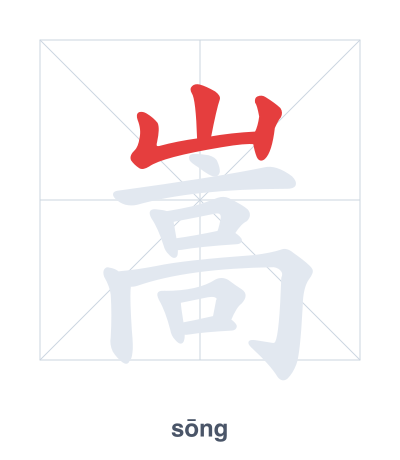
Open Hanzi Writer to see the animated stroke order and practice writing 嵩 with real-time feedback.
The character 嵩 (sōng) is written with 13 strokes. Follow the standard Chinese stroke order: top to bottom, left to right, outside before inside. The radical 山 is one of its key components.
Practice the correct stroke order with the Hanzi Writer app to see animated stroke-by-stroke guidance with real-time feedback.
嵩 means lofty / high.
嵩 is a compound character: the radical 山 (mountain) on top combines with 高 (high) below, visually and semantically reinforcing the idea of a mountain that is extremely tall or lofty.
💡 Memory Tip: Picture a towering mountain (山) that is so high (高) its peak pierces the clouds, making it truly 嵩 (lofty).
嵩山是五岳之一。
sōng shān shì wǔ yuè zhī yī
Mount Song is one of the Five Sacred Mountains.
山势嵩高峻拔。
shān shì sōng gāo jùn bá
The mountain is high and steep.
众人齐声嵩呼。
zhòng rén qí shēng sōng hū
Everyone shouted 'Long live' in unison.
Open Hanzi Writer to see the animated stroke order and practice writing 嵩 with real-time feedback.
✨ Animated stroke order · Handwriting recognition · HSK-graded practice · Free to use
嵩 consists of the radical 山 (mountain) on top and 高 (high) below. Since a high mountain suggests loftiness, the character naturally means 'lofty' or 'high'.