盥 (guàn) means "to wash (hands or face)" in Chinese. It has 16 strokes with the radical 皿.
Rated 3.8/5 in difficulty (challenging).
Appears in 3+ common words including 盥洗室 (guàn xǐ shì), 盥洗 (guàn xǐ), 盥洗盆 (guàn xǐ pén).
Due to its 16 strokes, Hanzi Writer's error detection shows 盥 requires focused practice — most learners need 10+ attempts for consistent accuracy.
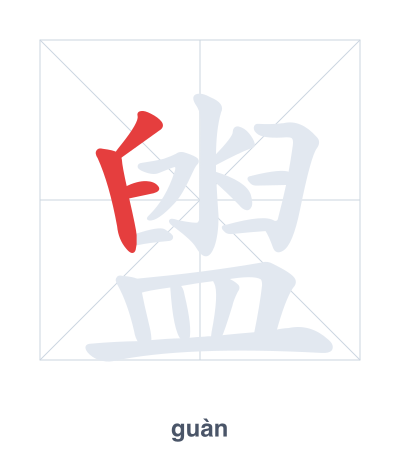
Open Hanzi Writer to see the animated stroke order and practice writing 盥 with real-time feedback.
The character 盥 (guàn) is written with 16 strokes. Follow the standard Chinese stroke order: top to bottom, left to right, outside before inside. The radical 皿 is one of its key components.
Practice the correct stroke order with the Hanzi Writer app to see animated stroke-by-stroke guidance with real-time feedback.
盥 means to wash (hands or face).
| Character | 盥 |
| Pinyin | guàn (guan) |
| Meaning | to wash (hands or face) |
| Strokes | 16 |
| Radical | 皿 |
| Difficulty | 3.8/5 |
The character 盥 combines 臼 (two hands), 水 (water, often written as 氵), and 皿 (a basin), depicting hands washing in a basin with water. Its ancient form showed hands over a vessel with water droplets, illustrating the act of washing hands or face.
💡 Memory Tip: Two hands (臼) splash water (水) into a basin (皿) to wash.
盥洗室在走廊尽头。
guàn xǐ shì zài zǒu láng jìn tóu
The washroom is at the end of the hallway.
饭前要进行盥洗。
fàn qián yào jìn xíng guàn xǐ
Wash up before meals.
盥洗盆里有很多水。
guàn xǐ pén lǐ yǒu hěn duō shuǐ
There is a lot of water in the washbasin.
Open Hanzi Writer to see the animated stroke order and practice writing 盥 with real-time feedback.
✨ Animated stroke order · Handwriting recognition · HSK-graded practice · Free to use
盥 is composed of the radical 皿 (a vessel or basin) at the bottom, and the top part is a combination of 臼 (a mortar) and 水 (water). The top suggests water being poured from a container into a basin, representing the action of washing hands or face.