梏 (gù) means "Shackles or to restrain" in Chinese. It has 11 strokes with the radical 木.
Rated 4.2/5 in difficulty (advanced).
Appears in 3+ common words including 桎梏 (zhì gù), 梏住 (gù zhù), 梏足 (gù zú).
Due to its 11 strokes, Hanzi Writer's error detection shows 梏 requires focused practice — most learners need 10+ attempts for consistent accuracy.
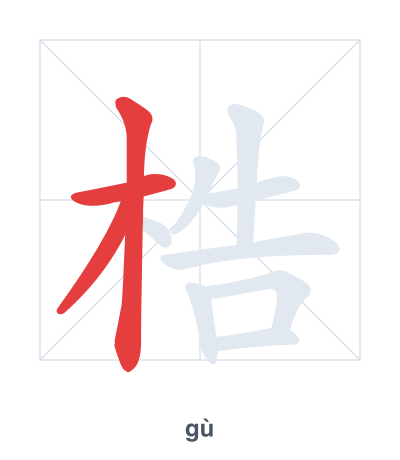
Open Hanzi Writer to see the animated stroke order and practice writing 梏 with real-time feedback.
The character 梏 (gù) is written with 11 strokes. Follow the standard Chinese stroke order: top to bottom, left to right, outside before inside. The radical 木 is one of its key components.
Practice the correct stroke order with the Hanzi Writer app to see animated stroke-by-stroke guidance with real-time feedback.
梏 means Shackles or to restrain.
梏 is a compound character: the radical 木 (wood) indicates the material, and 告 (gào) provides the sound. Ancient Chinese used wooden stocks or handcuffs to restrain prisoners, hence the meaning 'shackles' or 'to restrain'. The character visually combines 'wood' with the phonetic element 告, which originally depicted an ox with a mouth, but here it serves only as a sound component.
💡 Memory Tip: Picture a wooden tree (木) with a huge padlock (告 looks like a lock with a chain) clamped around it, so tightly that it's shackled and can't move.
他想打破生活的桎梏。
tā xiǎng dǎ pò shēng huó de zhì gù
He wants to break the shackles of life.
他的手被梏住了。
tā de shǒu bèi gù zhù le
His hands were shackled.
他被梏足在家里。
tā bèi gù zú zài jiā lǐ
He was confined at home.
Open Hanzi Writer to see the animated stroke order and practice writing 梏 with real-time feedback.
✨ Animated stroke order · Handwriting recognition · HSK-graded practice · Free to use
梏 is made of the radical 木 (wood) on the left and 告 (to tell) on the right. The wood radical suggests the material of ancient shackles, while 告 provides pronunciation and hints at the idea of 'announcing' restraint.