桎 (zhì) means "Fetters / Shackles for the feet" in Chinese. It has 10 strokes with the radical 木.
Rated 4.2/5 in difficulty (advanced).
Appears in 3+ common words including 桎梏 (zhì gù), 桎槛 (zhì kǎn), 桎拲 (zhì gǒng).
Due to its 10 strokes, Hanzi Writer's error detection shows 桎 requires focused practice — most learners need 10+ attempts for consistent accuracy.
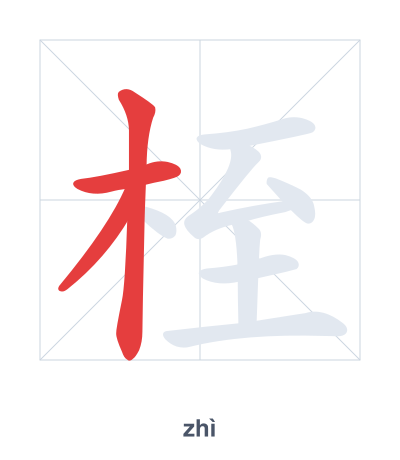
Open Hanzi Writer to see the animated stroke order and practice writing 桎 with real-time feedback.
The character 桎 (zhì) is written with 10 strokes. Follow the standard Chinese stroke order: top to bottom, left to right, outside before inside. The radical 木 is one of its key components.
Practice the correct stroke order with the Hanzi Writer app to see animated stroke-by-stroke guidance with real-time feedback.
桎 means Fetters / Shackles for the feet.
桎 is a compound character with the radical 木 (wood) indicating that ancient fetters were made of wood, and 至 (arrive/to stop) as a phonetic component that also suggests the idea of restraining movement. The combination literally depicts wooden devices that stop or restrain the feet.
💡 Memory Tip: Imagine a wooden block (木) with a tight strap (至) wrapped around your ankles, leaving you unable to move—those are the fetters.
他打破了旧思想的桎梏。
tā dǎ pò le jiù sī xiǎng de zhì gù
He broke the shackles of old ideas.
古代用桎槛关押囚犯。
gǔ dài yòng zhì kǎn guān yā qiú fàn
Ancient times used shackles and cages to detain prisoners.
桎拲是古代的一种刑具。
zhì gǒng shì gǔ dài de yī zhǒng xíng jù
Handcuffs and fetters were a type of punishment tool in ancient times.
Open Hanzi Writer to see the animated stroke order and practice writing 桎 with real-time feedback.
✨ Animated stroke order · Handwriting recognition · HSK-graded practice · Free to use
桎 is made of two parts: the left side 木 (wood) and the right side 至 (meaning 'to reach' or 'arrive'). Since ancient fetters were often made of wood, 木 indicates the material, while 至 suggests the idea of being bound or reaching a restricted state.