遘 (gòu) means "To meet; to encounter" in Chinese. It has 13 strokes with the radical 辶.
Rated 4.2/5 in difficulty (advanced).
Appears in 3+ common words including 遘遇 (gòu yù), 遘疾 (gòu jí), 遘会 (gòu huì).
Due to its 13 strokes, Hanzi Writer's error detection shows 遘 requires focused practice — most learners need 10+ attempts for consistent accuracy.
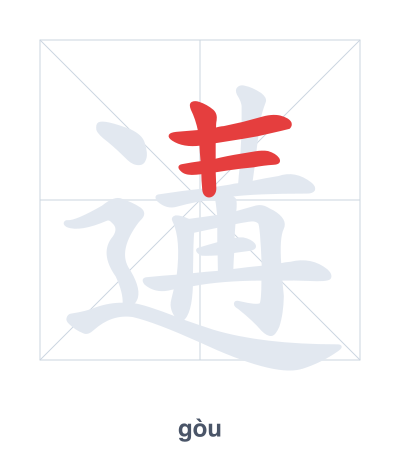
Open Hanzi Writer to see the animated stroke order and practice writing 遘 with real-time feedback.
The character 遘 (gòu) is written with 13 strokes. Follow the standard Chinese stroke order: top to bottom, left to right, outside before inside. The radical 辶 is one of its key components.
Practice the correct stroke order with the Hanzi Writer app to see animated stroke-by-stroke guidance with real-time feedback.
遘 means To meet; to encounter.
遘 combines the radical 辶 (walk) with 冓, which originally depicted two fish facing each other—a symbol of meeting. The walking radical adds movement, so the whole character means 'to go and meet' or 'to encounter' someone or something.
💡 Memory Tip: Imagine walking (辶) along a river when two fish (冓, like two fish face-to-face) suddenly leap up to meet you in a surprising encounter.
他在旅途中遘遇好友。
tā zài lǚ tú zhōng gòu yù hǎo yǒu
He happened to meet a good friend during his trip.
他不不幸遘疾去世。
tā bù bù xìng gòu jí qù shì
He unfortunately fell ill and passed away.
这是一个偶然的遘会。
zhè shì yí gè ǒu rán de gòu huì
This is a chance encounter.
Open Hanzi Writer to see the animated stroke order and practice writing 遘 with real-time feedback.
✨ Animated stroke order · Handwriting recognition · HSK-graded practice · Free to use
遘 is composed of the radical 辶 (walk) on the left and the component 冓 (gòu, meaning 'to meet' or 'structure') on the right. The radical indicates movement or action, and 冓 gives the sound and the core idea of meeting. Together, 遘 means 'to meet' or 'encounter' while walking.