咯 (gē) means "cluck; chuckle; (sentence-final particle)" in Chinese. It has 9 strokes with the radical 口.
Rated 4/5 in difficulty (challenging).
Appears in 3+ common words including 咯咯 (gē gē), 好咯 (hǎo gē), 行咯 (xíng gē).
Due to its 9 strokes, Hanzi Writer's error detection shows 咯 requires focused practice — most learners need 10+ attempts for consistent accuracy.
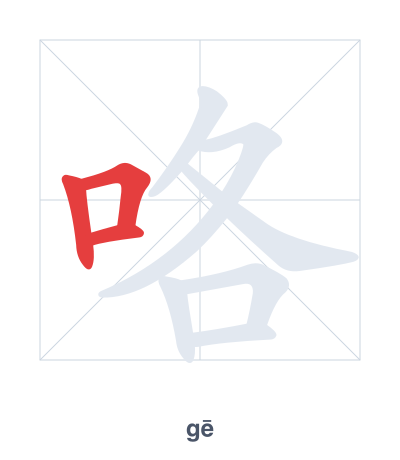
Open Hanzi Writer to see the animated stroke order and practice writing 咯 with real-time feedback.
The character 咯 (gē) is written with 9 strokes. Follow the standard Chinese stroke order: top to bottom, left to right, outside before inside. The radical 口 is one of its key components.
Practice the correct stroke order with the Hanzi Writer app to see animated stroke-by-stroke guidance with real-time feedback.
咯 means cluck; chuckle; (sentence-final particle).
咯 is a phono-semantic compound: the radical 口 (mouth) shows it relates to sounds, while 各 (gè) hints at pronunciation and also depicts a foot (夂) over a mouth (口), together suggesting the repeated, rhythmic sound of a chicken clucking or a soft chuckle.
💡 Memory Tip: Picture a chicken's beak (口) opening to cluck 'ge-ge,' with its legs (各) scratching the ground.
孩子咯咯地笑。
hái zi gē gē dì xiào
The child is giggling.
好咯,我知道了。
hǎo gē wǒ zhī dào le
Okay, I get it.
那就行咯。
nà jiù xíng gē
That's fine then.
Open Hanzi Writer to see the animated stroke order and practice writing 咯 with real-time feedback.
✨ Animated stroke order · Handwriting recognition · HSK-graded practice · Free to use
咯 is made of the radical 口 (mouth) on the left and the phonetic component 各 (gè) on the right. The mouth radical suggests sounds or actions involving the mouth, like chuckling or clucking. The right side 各 gives the character its pronunciation clue.