筏 (fá) means "Raft" in Chinese. It has 12 strokes with the radical 竹.
Rated 4.2/5 in difficulty (advanced).
Appears in 3+ common words including 竹筏 (zhú fá), 木筏 (mù fá), 皮筏 (pí fá).
Due to its 12 strokes, Hanzi Writer's error detection shows 筏 requires focused practice — most learners need 10+ attempts for consistent accuracy.
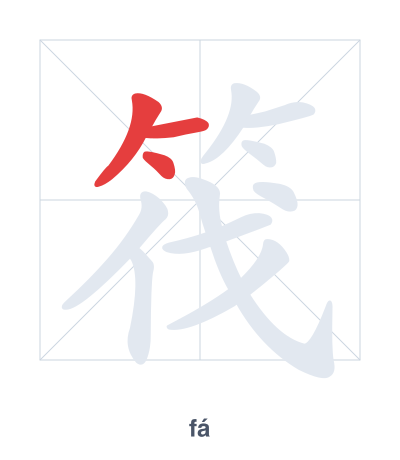
Open Hanzi Writer to see the animated stroke order and practice writing 筏 with real-time feedback.
The character 筏 (fá) is written with 12 strokes. Follow the standard Chinese stroke order: top to bottom, left to right, outside before inside. The radical 竹 is one of its key components.
Practice the correct stroke order with the Hanzi Writer app to see animated stroke-by-stroke guidance with real-time feedback.
筏 means Raft.
筏 is a compound character formed by the radical 竹 (bamboo) and the phonetic component 伐 (fá, meaning 'to cut'). The bamboo radical indicates the material, while 伐 suggests the action of cutting bamboo to make a raft, showing a vessel constructed from tied bamboo logs.
💡 Memory Tip: Picture a bamboo raft (竹) where a person (亻) uses a halberd (弋) to chop and lash logs together, forming a floating platform.
我们坐竹筏过河。
wǒ men zuò zhú fá guò hé
We crossed the river by bamboo raft.
他造了一个小木筏。
tā zào le yí gè xiǎo mù fá
He built a small wooden raft.
皮筏在水上漂流。
pí fá zài shuǐ shàng piāo liú
The skin raft is drifting on the water.
Open Hanzi Writer to see the animated stroke order and practice writing 筏 with real-time feedback.
✨ Animated stroke order · Handwriting recognition · HSK-graded practice · Free to use
筏 has the radical 竹 (bamboo) on top, which hints that the character relates to bamboo. The lower part is 伐 (fá, meaning 'to cut down'), which also gives the pronunciation. Together, bamboo + cutting suggests a raft made from cut bamboo.