掇 (duō) means "to pick up; to collect" in Chinese. It has 11 strokes with the radical 扌.
Rated 4.2/5 in difficulty (advanced).
Appears in 3+ common words including 拾掇 (shí duō), 掇弄 (duō nòng), 掇拾 (duō shí).
Due to its 11 strokes, Hanzi Writer's error detection shows 掇 requires focused practice — most learners need 10+ attempts for consistent accuracy.
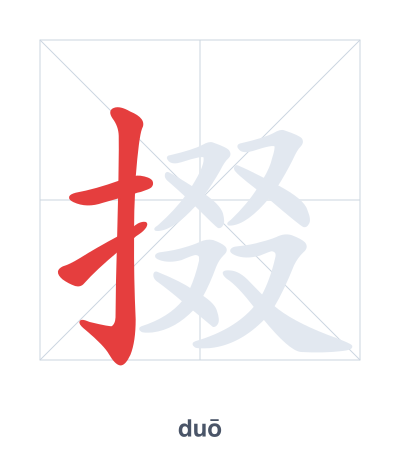
Open Hanzi Writer to see the animated stroke order and practice writing 掇 with real-time feedback.
The character 掇 (duō) is written with 11 strokes. Follow the standard Chinese stroke order: top to bottom, left to right, outside before inside. The radical 扌 is one of its key components.
Practice the correct stroke order with the Hanzi Writer app to see animated stroke-by-stroke guidance with real-time feedback.
掇 means to pick up; to collect.
The character 掇 combines the hand radical 扌 (a pictograph of a hand) with 叕 (a component depicting threads being joined, suggesting connection or gathering). Together, they convey the action of using one's hand to collect or pick up multiple items.
💡 Memory Tip: Imagine a hand (扌) quickly picking up four scattered coins (叕 looks like four '又' shapes) off the ground.
我得拾掇一下房间。
wǒ dé shí duō yī xià fáng jiān
I need to tidy up the room.
他在掇弄那个收音机。
tā zài duō nòng nà ge shōu yīn jī
He is fiddling with that radio.
他在地上掇拾落叶。
tā zài dì shàng duō shí luò yè
He is picking up fallen leaves from the ground.
Open Hanzi Writer to see the animated stroke order and practice writing 掇 with real-time feedback.
✨ Animated stroke order · Handwriting recognition · HSK-graded practice · Free to use
The character 掇 combines the radical 扌 (hand) on the left with 叕 on the right. The hand radical indicates actions involving the hand, while 叕 originally meant "to connect" or "to sew," together suggesting picking up or collecting scattered items. Thus, 掇 carries the meaning of gathering things with your hand.