澹 (dàn) means "Quiet / Tranquil" in Chinese. It has 16 strokes with the radical 氵.
Rated 4.2/5 in difficulty (advanced).
Appears in 3+ common words including 澹泊 (dàn pō), 澹然 (dàn rán), 恬澹 (tián dàn).
Due to its 16 strokes, Hanzi Writer's error detection shows 澹 requires focused practice — most learners need 10+ attempts for consistent accuracy.
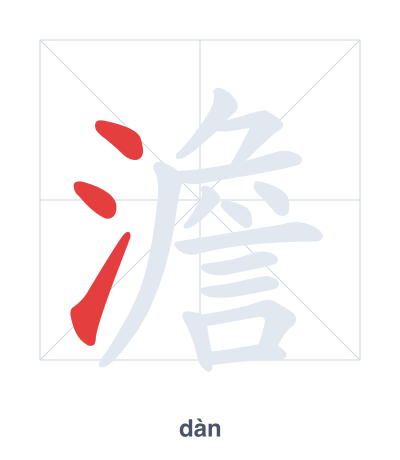
Open Hanzi Writer to see the animated stroke order and practice writing 澹 with real-time feedback.
The character 澹 (dàn) is written with 16 strokes. Follow the standard Chinese stroke order: top to bottom, left to right, outside before inside. The radical 氵 is one of its key components.
Practice the correct stroke order with the Hanzi Writer app to see animated stroke-by-stroke guidance with real-time feedback.
澹 means Quiet / Tranquil.
澹 is a phono-semantic compound combining the water radical 氵 (indicating calm or still water) with 詹 (zhān), which here contributes the pronunciation and subtly hints at the idea of 'excessive talk'—the character's original sense of 'water settling' evolved into 'tranquil, quiet'.
💡 Memory Tip: A calm lake (氵) reflects a silent monk (詹, picturing a person with a hat and a speech bubble crossed out), showing that true peace comes from stillness, not words.
他生活很澹泊。
tā shēng huó hěn dàn pō
He lives a simple and quiet life.
他澹然一笑。
tā dàn rán yī xiào
He gave a calm smile.
心境恬澹。
xīn jìng tián dàn
A peaceful and indifferent state of mind.
Open Hanzi Writer to see the animated stroke order and practice writing 澹 with real-time feedback.
✨ Animated stroke order · Handwriting recognition · HSK-graded practice · Free to use
澹 combines the water radical 氵 (meaning water or liquid) with the phonetic component 詹 (zhān). The water radical suggests a calm, still surface of water, which connects to the meaning of quietness and tranquility.