恬 (tián) means "calm" in Chinese. It has 9 strokes with the radical 忄.
Rated 4/5 in difficulty (challenging).
Appears in 3+ common words including 恬静 (tián jìng), 恬淡 (tián dàn), 恬不知耻 (tián bù zhī chǐ).
Due to its 9 strokes, Hanzi Writer's error detection shows 恬 requires focused practice — most learners need 10+ attempts for consistent accuracy.
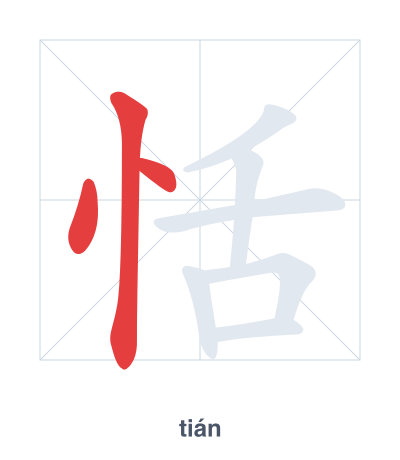
Open Hanzi Writer to see the animated stroke order and practice writing 恬 with real-time feedback.
The character 恬 (tián) is written with 9 strokes. Follow the standard Chinese stroke order: top to bottom, left to right, outside before inside. The radical 忄 is one of its key components.
Practice the correct stroke order with the Hanzi Writer app to see animated stroke-by-stroke guidance with real-time feedback.
恬 means calm.
恬 combines the heart radical (忄) with 舌 (tongue), forming a phono-semantic compound where 舌 suggests the sound tián. The tongue also evokes sweetness, so the whole character symbolizes a heart that is sweetly calm and tranquil.
💡 Memory Tip: Picture a calm heart (忄) with a tongue (舌) gently licking a piece of honey, savoring a peaceful sweetness.
这里的环境很恬静。
zhè lǐ de huán jìng hěn tián jìng
The environment here is very quiet and peaceful.
他过着恬淡的生活。
tā guò zhe tián dàn de shēng huó
He lives a quiet and simple life.
这个人恬不知耻。
zhè ge rén tián bù zhī chǐ
This person is completely shameless.
Open Hanzi Writer to see the animated stroke order and practice writing 恬 with real-time feedback.
✨ Animated stroke order · Handwriting recognition · HSK-graded practice · Free to use
恬 is made of the heart radical 忄 on the left, which connects to emotions or mind, and 舌 (tongue) on the right, which provides the pronunciation tián. Together, they suggest a heart that is quiet and still, like a peaceful inner state where even the tongue does not disturb.