锤 (chuí) means "Hammer" in Chinese. It has 13 strokes with the radical 钅, and is HSK Level 7.
Rated 4.2/5 in difficulty (advanced).
Harder than 95% of HSK Level 7 characters.
Appears in 3+ common words including 锤子 (chuí zi), 铁锤 (tiě chuí), 敲锤 (qiāo chuí).
Due to its 13 strokes, Hanzi Writer's error detection shows 锤 requires focused practice — most learners need 10+ attempts for consistent accuracy.
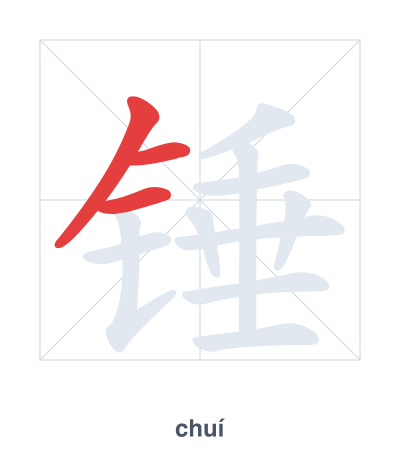
Open Hanzi Writer to see the animated stroke order and practice writing 锤 with real-time feedback.
The character 锤 (chuí) is written with 13 strokes. Follow the standard Chinese stroke order: top to bottom, left to right, outside before inside. The radical 钅 is one of its key components.
Practice the correct stroke order with the Hanzi Writer app to see animated stroke-by-stroke guidance with real-time feedback.
锤 means Hammer.
As an HSK Level 7 character, 锤 is an intermediate-level character.
锤 is a compound character with the radical 钅 (metal, indicating the material) and the phonetic component 垂 (chuí, meaning 'to hang down'). The combination suggests a metal tool with a heavy head that hangs or swings, like a hammer. In ancient times, hammers were often depicted as a weighted head attached to a handle, aligning with the 'hanging' imagery of 垂.
💡 Memory Tip: Imagine a metal hammer (钅) hanging (垂) from a belt loop, ready to swing down with force.
请给我一把锤子。
qǐng gěi wǒ yī bǎ chuí zi
Please give me a hammer.
铁锤很重。
tiě chuí hěn zhòng
The iron hammer is very heavy.
他在用力敲锤。
tā zài yòng lì qiāo chuí
He is hammering hard.
Open Hanzi Writer to see the animated stroke order and practice writing 锤 with real-time feedback.
✨ Animated stroke order · Handwriting recognition · HSK-graded practice · Free to use
锤 is made of the metal radical 钅 on the left and 垂 on the right. The metal radical tells you that a hammer is a metal tool, while 垂 gives the pronunciation and visually suggests a hanging or drooping shape, like a hammer's handle.