绌 (chù) means "Insufficient or short of" in Chinese. It has 8 strokes with the radical 纟.
Rated 3.7/5 in difficulty (challenging).
Appears in 3+ common words including 见绌 (jiàn chù), 支绌 (zhī chù), 绌劣 (chù liè).
Due to its 8 strokes, Hanzi Writer's error detection shows 绌 requires focused practice — most learners need 10+ attempts for consistent accuracy.
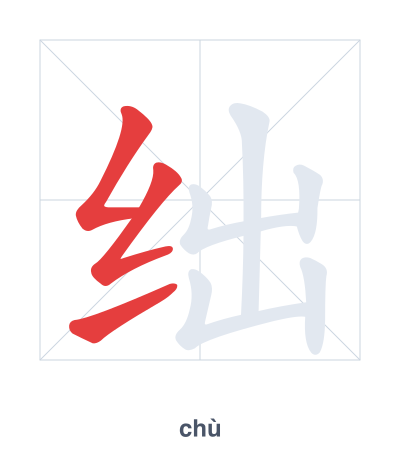
Open Hanzi Writer to see the animated stroke order and practice writing 绌 with real-time feedback.
The character 绌 (chù) is written with 8 strokes. Follow the standard Chinese stroke order: top to bottom, left to right, outside before inside. The radical 纟 is one of its key components.
Practice the correct stroke order with the Hanzi Writer app to see animated stroke-by-stroke guidance with real-time feedback.
绌 means Insufficient or short of.
This is a phono-semantic compound where 纟 (silk) hints at fabric or threads, and 出 (chū, 'to go out') provides the sound. The original meaning referred to a shortfall in silk—either a thread that runs out or a cloth that is too short—hence 'insufficient' or 'lacking'.
💡 Memory Tip: Imagine a silk thread (纟) that comes to an end too quickly (出 like a little piece sticking out), leaving you short of what you need.
他的技术相形见绌。
tā de jì shù xiāng xíng jiàn chù
His skill pales in comparison.
这个月的钱有点支绌。
zhè ge yuè de qián yǒu diǎn zhī chù
Money is a bit tight this month.
他的表现很绌劣。
tā de biǎo xiàn hěn chù liè
His performance was very poor.
Open Hanzi Writer to see the animated stroke order and practice writing 绌 with real-time feedback.
✨ Animated stroke order · Handwriting recognition · HSK-graded practice · Free to use
绌 is composed of the radical 纟 (silk thread) on the left, which often relates to textiles or binding, and 出 (chū, to go out) on the right. The combination evokes the idea of silk that is "running out" or insufficient, linking to the character's meaning of being short or deficient.