惆 (chóu) means "Melancholy" in Chinese. It has 11 strokes with the radical 忄.
Rated 4.2/5 in difficulty (advanced).
Appears in 3+ common words including 惆怅 (chóu chàng), 惆然 (chóu rán), 惆惋 (chóu wǎn).
Due to its 11 strokes, Hanzi Writer's error detection shows 惆 requires focused practice — most learners need 10+ attempts for consistent accuracy.
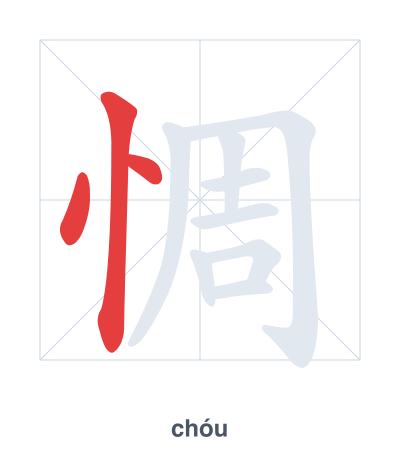
Open Hanzi Writer to see the animated stroke order and practice writing 惆 with real-time feedback.
The character 惆 (chóu) is written with 11 strokes. Follow the standard Chinese stroke order: top to bottom, left to right, outside before inside. The radical 忄 is one of its key components.
Practice the correct stroke order with the Hanzi Writer app to see animated stroke-by-stroke guidance with real-time feedback.
惆 means Melancholy.
惆 is a phono-semantic compound where the heart radical 忄 indicates an emotion, and 周 (zhōu) provides the sound. The character conveys the heavy, lingering feeling of melancholy as if the heart is trapped in a cycle of sadness (周 can also mean 'circuit' or 'all around').
💡 Memory Tip: Imagine a heart (忄) stuck in a week-long (周) loop of sorrow, feeling truly melancholy.
他心里感到很惆怅。
tā xīn lǐ gǎn dào hěn chóu chàng
He feels very melancholy.
他惆然若失地站着。
tā chóu rán ruò shī dì zhàn zhe
He stood there feeling lost and melancholy.
听到消息他很惆惋。
tīng dào xiāo xī tā hěn chóu wǎn
He was very sorrowful upon hearing the news.
Open Hanzi Writer to see the animated stroke order and practice writing 惆 with real-time feedback.
✨ Animated stroke order · Handwriting recognition · HSK-graded practice · Free to use
The character 惆 consists of the heart radical 忄 on the left and the phonetic component 周 on the right. The heart radical connects the character to emotions, and 周 adds the pronunciation, together forming the meaning of melancholy, which is a feeling of the heart.