怅 (chàng) means "disappointed; regretful; listless" in Chinese. It has 7 strokes with the radical 忄.
Rated 3.5/5 in difficulty (challenging).
Appears in 3+ common words including 怅然 (chàng rán), 怅惘 (chàng wǎng), 悲怅 (bēi chàng).
Due to its 7 strokes, Hanzi Writer's error detection shows 怅 requires focused practice — most learners need 10+ attempts for consistent accuracy.
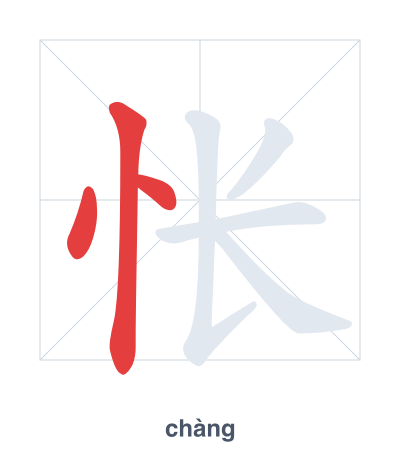
Open Hanzi Writer to see the animated stroke order and practice writing 怅 with real-time feedback.
The character 怅 (chàng) is written with 7 strokes. Follow the standard Chinese stroke order: top to bottom, left to right, outside before inside. The radical 忄 is one of its key components.
Practice the correct stroke order with the Hanzi Writer app to see animated stroke-by-stroke guidance with real-time feedback.
怅 means disappointed; regretful; listless.
The character 怅 combines the heart radical 忄 (心) with 长 (long), suggesting a lingering or extended emotional state of disappointment or regret.
💡 Memory Tip: Picture a long (长) heart (忄) drooping with disappointment.
他怅然若失。
tā chàng rán ruò shī
He felt a sense of loss.
他感到有些怅惘。
tā gǎn dào yǒu xiē chàng wǎng
He feels a bit listless and lost.
心中充满悲怅。
xīn zhōng chōng mǎn bēi chàng
The heart is filled with sorrow and grief.
Open Hanzi Writer to see the animated stroke order and practice writing 怅 with real-time feedback.
✨ Animated stroke order · Handwriting recognition · HSK-graded practice · Free to use
The character 怅 combines the heart radical 忄 on the left and 长 (cháng, long) on the right. The heart radical indicates that the character relates to emotions or feelings, while 长 hints at a prolonged or lingering state—together suggesting a lasting feeling of disappointment or regret.